Surface finishing is often treated as an afterthought — the “last step” of the process — but it directly impacts corrosion resistance, wear resistance, cosmetic consistency, and even final dimensional tolerance on critical fits. This article systematically covers common surface finish options for CNC-machined parts and how to select the right one at the design stage.
1. Mechanical Finishes
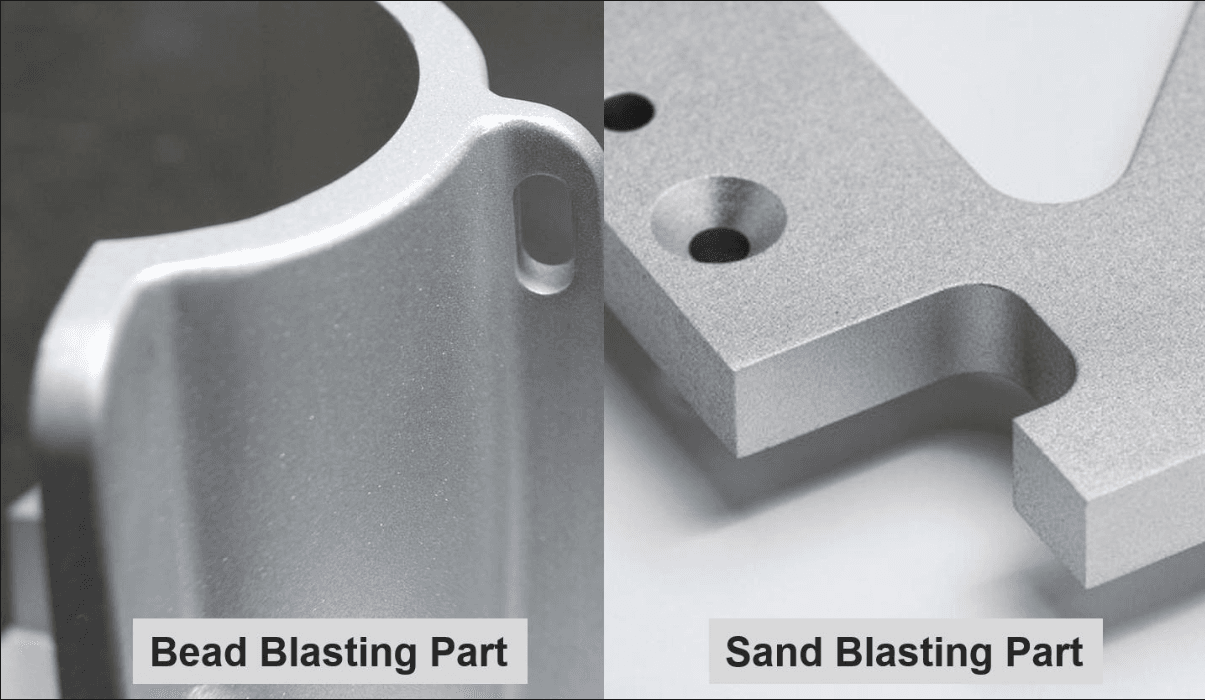
Bead Blasting
High-pressure spraying of glass beads or ceramic media produces a uniform matte, textured finish. Commonly used on aluminum and stainless steel parts for cosmetic purposes, and also as a pre-treatment before anodizing or coating to improve adhesion. Blast media grit size (80#, 120#, 180#, etc.) significantly affects resulting surface roughness and should be specified explicitly on the drawing.
Polishing
Includes mechanical polishing and electropolishing. Mechanical polishing achieves a mirror finish, commonly used for cosmetic parts. Electropolishing removes surface micro-burrs through an electrochemical process while also improving corrosion resistance, commonly used for medical devices and food-grade stainless steel parts.
2. Chemical and Electrochemical Finishes
Anodizing
Applicable only to aluminum alloys. Comes in standard anodizing (Type II) and hard-coat anodizing (Type III). Standard anodizing produces a film thickness of roughly 5-25 microns, can be dyed for color, and offers both cosmetic and baseline corrosion protection. Hard-coat anodizing can reach 25-75 microns and significantly increases surface hardness (up to HV400+), suited for wear-resistant moving parts. Important: anodizing increases part dimensions — precision fit dimensions must have coating thickness allowance built into the drawing.
Electroless Nickel Plating
Applicable to many metal substrates, with more uniform coverage than electroplating, especially useful for complex internal cavities. Provides good corrosion resistance and moderate wear resistance, commonly used for hydraulic valve bodies and precision instrument components.
Passivation
For stainless steel — an acid treatment that removes free iron from the surface to improve corrosion resistance without changing dimensions or appearance. A standard, low-cost step for medical and food-grade stainless parts.
Black Oxide
Primarily used on carbon and alloy steels, forming a thin oxide layer for mild rust protection and a low-glare cosmetic appearance. Doesn’t provide significant corrosion resistance on its own and is typically paired with an oil coating.
3. Coating Options
Powder Coating
Coating thickness typically 50-120 microns, with better adhesion and weatherability than liquid paint — suited for outdoor equipment enclosures.
PVD Coating (Physical Vapor Deposition)
Enables hard coatings like TiN and TiAlN, significantly improving surface hardness and wear resistance. Commonly used on cutting tools and high-wear precision parts, at a higher cost that delivers meaningful performance gains.
4. Dimensional Impact — A Shared Concern for Design and Procurement
| Process | Typical Dimensional Change | Tolerance Allowance Needed |
|---|---|---|
| Standard Anodizing | +5–15 microns (both sides) | Yes |
| Hard-Coat Anodizing | +25–75 microns (both sides) | Yes, significant impact |
| Electroless Nickel | +8–20 microns | Yes |
| Bead Blasting | Negligible, but affects Ra roughness | No |
| Passivation | Negligible | No |
Precision fit dimensions (shaft-hole fits, threads) should specify explicitly on the drawing whether the tolerance applies “before” or “after” finishing — otherwise, disputes at acceptance are common, especially with hard-coat anodizing where the film thickness effect is significant.
5. Advice for Procurement Engineers
- When quoting, specify the exact process spec (e.g., MIL-A-8625 Type II Class 1) rather than a generic “anodizing” — costs and lead times vary significantly by spec
- Surface finishing is typically outsourced by the CNC shop to a specialized plating/anodizing vendor, adding 3-7 business days to lead time — build this into your schedule
- For volume orders with color-critical requirements, request color panel samples and a ΔE color difference report to avoid batch-to-batch color discrepancies
Surface finish selection should return to the part’s actual use case — is it purely cosmetic, or does it serve a functional need for corrosion or wear resistance? That determines the right process route and cost budget.