
A Practical Guide to 5-Axis CNC Machining, Tight Tolerances, Inspection, and Supplier Selection
Finding a CNC milling company for an aerospace prototype is very different from finding a supplier for a standard machined part.
An aerospace prototype may only require a few pieces, but those parts can involve complex geometries, difficult materials, tight dimensional tolerances, demanding GD&T requirements, controlled surface finishes, and extensive inspection documentation.
For engineers and aerospace procurement teams, the real question is not simply:
Which CNC company has a 5-axis machine?
The better question is:
Which CNC milling company can repeatedly manufacture my specific aerospace prototype to the required tolerances and provide objective inspection evidence?
This distinction matters because a machine’s advertised accuracy does not automatically translate into part-level accuracy.
A successful aerospace prototype supplier needs a combination of:
- Advanced CNC milling capability
- 5-axis machining when appropriate
- Aerospace material experience
- Experienced CAM programming
- Stable workholding and process control
- Thermal management
- CMM inspection
- GD&T capability
- Material traceability
- Quality management systems
- Engineering and DFM support
This guide explains what to look for when selecting a CNC milling company for tight-tolerance aerospace prototype parts.
Quick Answer: What Type of CNC Company Should You Choose?
For aerospace prototypes with demanding tolerances, prioritize a supplier that can demonstrate:
| Capability | Why It Matters |
|---|---|
| 5-axis CNC milling | Access to complex aerospace geometries |
| Simultaneous 5-axis machining | Continuous tool orientation for complex surfaces |
| Aerospace material experience | Titanium, Inconel, aluminum, stainless steel |
| CMM inspection | Verification of critical dimensions and geometry |
| GD&T inspection | Controls position, profile, perpendicularity, etc. |
| DFM review | Identifies manufacturing risks before production |
| Material traceability | Supports aerospace documentation requirements |
| FAI capability | Useful for first-article qualification |
| Controlled machining environment | Helps maintain dimensional stability |
| Experienced CAM programming | Critical for complex surfaces |
| Prototype capability | Supports low-volume engineering programs |
| Quality management system | Provides documented process control |
Not every project requires every capability.
The appropriate supplier depends on the part geometry, material, tolerance, application, certification requirements, quantity, and inspection specification.
1. Why Aerospace Prototype Parts Are Difficult to Machine
Aerospace components often combine several challenging manufacturing requirements in a single part.
A prototype may include:
- Thin walls
- Deep pockets
- Complex 3D surfaces
- Tight positional tolerances
- Complex GD&T
- Lightweight structures
- Difficult-to-machine alloys
- Critical mating surfaces
- Tight concentricity requirements
- Low-volume production
- Extensive inspection requirements
For example, an aerospace housing may require lightweight pockets while maintaining structural rigidity.
An aerospace turbine-related component may contain complex curved surfaces.
A sensor mount may look simple but still require tight positional tolerances because it interfaces with other precision components.
The challenge is therefore not just cutting metal.
It is maintaining dimensional stability throughout:
CAD → CAM → Setup → Machining → Inspection → Finishing → Final Verification
2. What Does “Really Tight Tolerance” Mean in Aerospace CNC Machining?
There is no single tolerance that defines aerospace machining.
A part drawing might contain:
- ±0.1 mm
- ±0.05 mm
- ±0.02 mm
- ±0.01 mm
- ±0.005 mm
on different features.
The important point is that not every feature should necessarily have the same tolerance.
Aerospace drawings commonly use GD&T to control functional relationships such as:
- Position
- Profile
- Flatness
- Perpendicularity
- Parallelism
- Concentricity
- Runout
For example, a bearing bore may require much tighter control than a non-functional external surface.
Therefore, when evaluating a CNC milling company, don’t simply ask:
“Can you hold ±0.005 mm?”
Instead ask:
“Can you consistently achieve the tolerance and GD&T requirements on the critical features of our specific part?”
That is a much more meaningful supplier-qualification question.
3. 5-Axis CNC Milling for Aerospace Prototypes
Why 5-Axis Machining Matters
Aerospace components frequently contain complex surfaces that are difficult to machine efficiently with conventional 3-axis equipment.
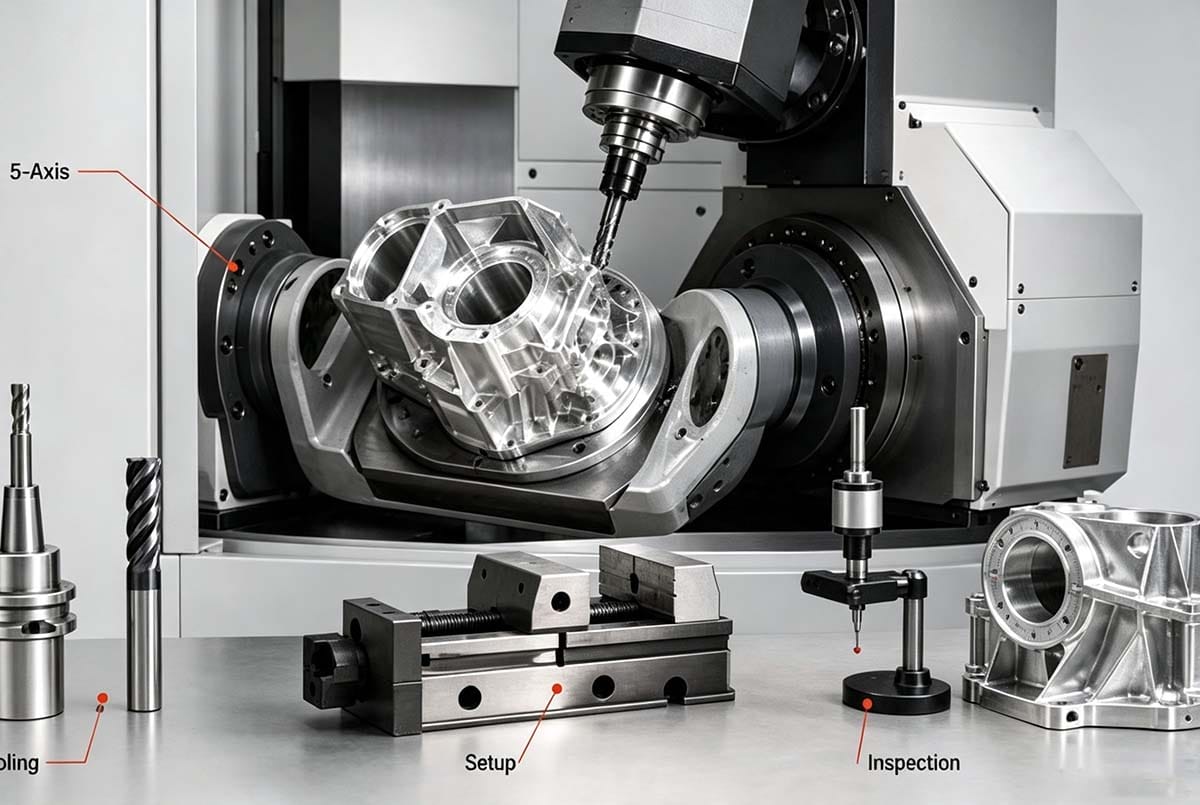
5-axis CNC machining allows the cutting tool and workpiece to be positioned from multiple directions.
With simultaneous 5-axis machining, the tool orientation can continuously change while following a complex surface.
Potential advantages include:
- Fewer setups
- Better tool access
- Reduced setup-related variation
- Shorter tool engagement
- Improved surface finish
- Better access to complex geometry
- Reduced risk of tolerance accumulation
Typical aerospace applications include:
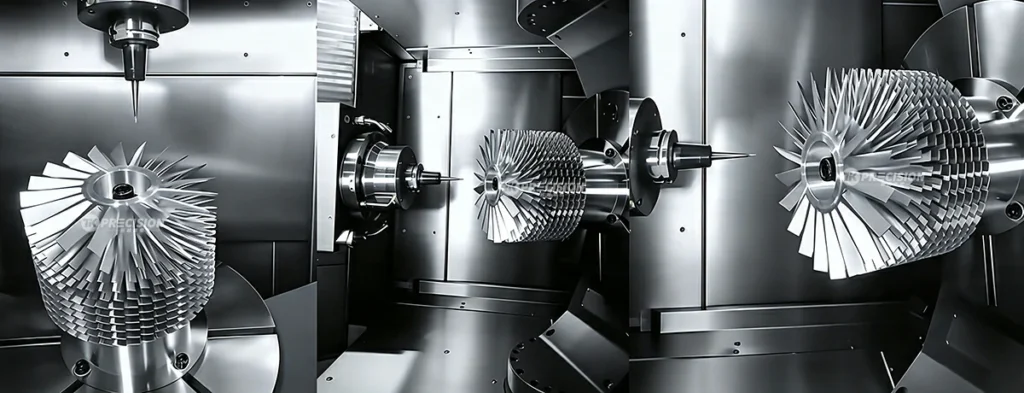
- Turbine components
- Compressor components
- Blades
- Vanes
- Blisks
- Structural components
- Complex housings
- Aerospace brackets
- Engine components
However, 5-axis machining is not automatically the best solution for every aerospace prototype.
A skilled manufacturer should determine the appropriate machining strategy based on the actual geometry.
4. True Simultaneous 5-Axis vs. 3+2 Machining
This is an important question to ask during supplier qualification.
A machine may have five axes but primarily be used for 3+2 positioning.
In 3+2 machining, the rotary axes position the workpiece or tool, then the cutting operation is performed with three linear axes.
In simultaneous 5-axis machining, multiple axes move continuously during cutting.
For complex aerospace surfaces, simultaneous 5-axis machining can provide significant advantages.
When requesting a quotation, ask:
“Will this component be machined using simultaneous 5-axis toolpaths or 3+2 positioning?”
Then ask:
“Why is that strategy appropriate for this geometry?”
The answer can tell you much more about the supplier’s engineering expertise than a machine specification sheet.
5. Aerospace Materials Require Specialized Machining Strategies
The best CNC milling company for aluminum may not be the best supplier for titanium or Inconel.
Aluminum
Common aerospace alloys include:
- 6061
- 7075
- 2024
- 7050
Aluminum is relatively machinable and is frequently used for:
- Structural prototypes
- Brackets
- Housings
- Test components
- Lightweight structures
However, thermal expansion and thin-wall deformation can still become important when tight tolerances are required.
Titanium
Titanium is widely used in aerospace because of its strength-to-weight ratio and corrosion resistance.
Common alloys include:
- Ti-6Al-4V
- Grade 2 titanium
Machining challenges include:
- Low thermal conductivity
- Heat concentration
- High cutting forces
- Tool wear
- Potential workpiece deformation
A supplier should have specific experience machining titanium rather than simply listing it among its available materials.
Inconel and Nickel-Based Alloys
Inconel 625 and Inconel 718 are used in demanding high-temperature environments.
They can be difficult to machine because of:
- High cutting forces
- Work hardening
- Heat generation
- Tool wear
- Difficult chip evacuation
Ask a potential supplier:
“How much experience do you have machining this specific alloy in similar aerospace geometries?”
Stainless Steel
Aerospace prototypes may also use:
- 15-5 PH
- 17-4 PH
- 304
- 316
The machining strategy depends heavily on material condition and hardness.
6. Thermal Stability Is Critical for Tight Tolerances
Temperature can affect dimensional accuracy.
When a part, machine, tooling system, or inspection equipment changes temperature, dimensions can change as well.
For demanding prototype work, a capable supplier may use:
- Temperature-controlled machining areas
- Controlled inspection environments
- Coolant management
- Thermal stabilization
- In-process probing
- Tool-length measurement
- Machine calibration procedures
However, the actual requirements depend on the tolerance and material.
When qualifying a supplier, ask:
“How do you control thermal effects during machining and inspection of tight-tolerance components?”
This is a much better question than simply asking whether the shop has an air-conditioned facility.
7. CMM Inspection: What Should You Expect?
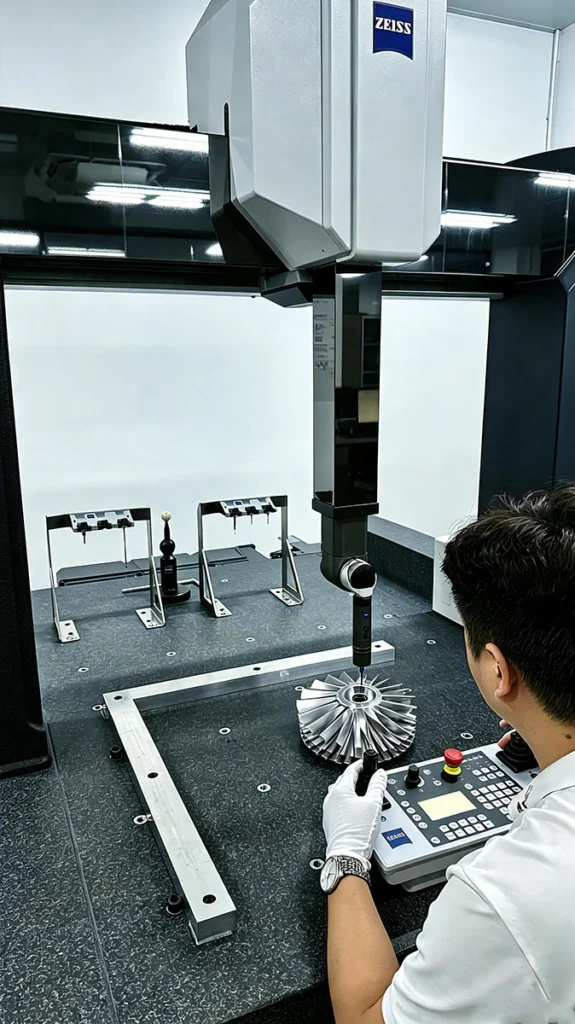
For complex aerospace prototype parts, dimensional inspection can be one of the most important supplier-selection criteria.
A capable CNC milling company may provide:
- CMM inspection
- Optical inspection
- Surface roughness measurement
- Height-gauge inspection
- Bore measurement
- Thread inspection
- GD&T verification
For complex freeform surfaces, CMM inspection can compare the manufactured component against the CAD model and drawing requirements.
Ask the supplier:
Which features will be inspected?
Will I receive actual measured values?
Can you provide a full dimensional inspection report?
Is the inspection equipment calibrated?
A statement such as “100% inspected” is less useful if the supplier cannot explain what was inspected and how it was measured.
8. First Article Inspection for Aerospace Prototypes
When aerospace customers require formal first-article qualification, suppliers may need to support First Article Inspection (FAI) documentation.
A commonly referenced aerospace standard is AS9102.
Depending on the customer’s requirements, an FAI package can document:
- Part characteristics
- Drawing requirements
- Actual measurements
- Material information
- Process information
- Inspection results
Not every prototype automatically requires AS9102 FAI.
The requirement should come from the customer’s quality system, purchase order, drawing, or contractual requirements.
When requesting a quote, ask:
“Can you provide FAI documentation if our program requires it?”
9. Material Traceability
Aerospace customers may require detailed material documentation.
Depending on the program, this can include:
- Material certificates
- Heat/lot information
- Certificate of Conformance
- Process certifications
- Heat treatment records
- Plating/coating certificates
- Special-process documentation
The important point is that traceability requirements should be established before production begins.
Don’t wait until the parts are finished to ask whether the supplier can provide the required documentation.
10. DFM Review for Aerospace Prototypes
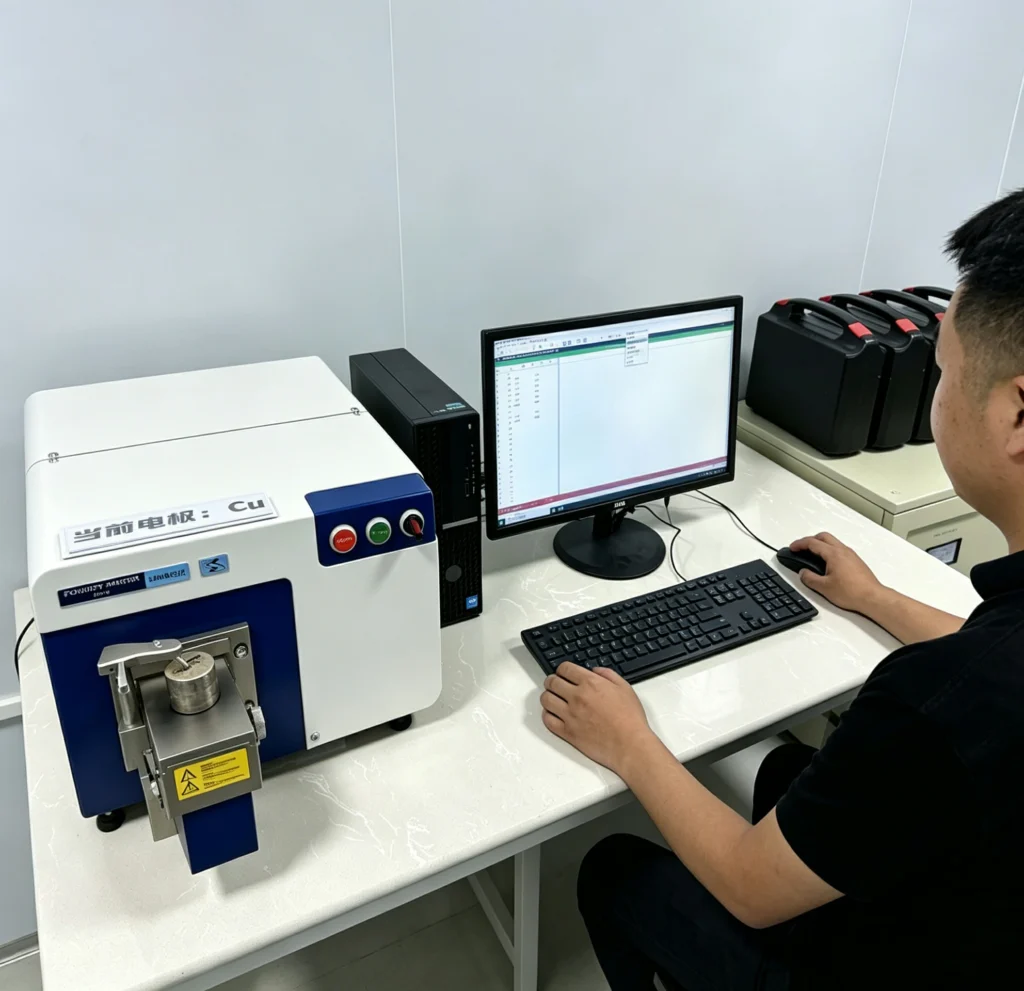
A professional CNC milling company should review the design before machining.
A useful aerospace DFM review may identify:
Thin-Wall Risks
Thin sections can deform during machining.
Deep-Pocket Problems
Long tools can create:
- Vibration
- Deflection
- Poor surface finish
- Dimensional variation
Internal Corner Radii
Extremely small internal radii can require very small cutters and significantly increase machining time.
Tool Access
The supplier should determine whether the cutter and holder can reach all required surfaces.
Tolerance Strategy
Extremely tight tolerances should be limited to functionally critical features whenever possible.
Workholding
A thin aerospace component may require specialized fixturing to prevent distortion.
Good DFM feedback can reduce:
- Prototype cost
- Machining time
- Rework
- Scrap
- Engineering delays
11. What Aerospace CNC Milling Companies Should You Consider?
Rather than choosing a supplier based purely on a “Top 10” ranking, divide potential manufacturers into categories.
Category 1: Aerospace-Focused CNC Manufacturers
These companies primarily serve aerospace or other highly regulated industries.
They may offer:
- AS9100 quality systems
- Aerospace material traceability
- FAI
- Complex 5-axis machining
- Difficult alloy experience
They are often suitable for demanding aerospace programs.
Category 2: Precision CNC Prototype Specialists
These companies may serve multiple industries but specialize in:
- Prototypes
- Complex CNC machining
- Low-volume production
- Engineering support
- Rapid iteration
They can be particularly attractive when the project is still in the development stage.
Category 3: General CNC Machine Shops
These suppliers may be suitable for:
- Simple brackets
- Fixtures
- Non-critical components
- Early conceptual prototypes
But you should carefully verify their aerospace quality and inspection capabilities before using them for flight-related or highly critical components.
12. How to Compare CNC Milling Companies
Use a qualification matrix instead of comparing prices alone.
| Criteria | Questions to Ask |
|---|---|
| 5-axis | Do you offer simultaneous 5-axis machining? |
| Aerospace experience | Have you machined similar aerospace components? |
| Material | Have you machined this exact alloy? |
| Tolerance | What is your demonstrated capability for similar features? |
| GD&T | Can you inspect complex GD&T requirements? |
| CMM | What CMM equipment do you use? |
| FAI | Can you support AS9102 FAI if required? |
| Traceability | Can you provide material and process records? |
| DFM | Is engineering review included? |
| Prototype | Can you manufacture small quantities? |
| Production | Can you scale if the prototype succeeds? |
| Lead time | What is the realistic lead time? |
| Quality | What quality certifications apply to the production facility? |
13. Questions to Ask Before Requesting a Quote
Questions for Engineering
Ask:
What machining strategy would you recommend for this component?
Would you use 3-axis, 3+2, or simultaneous 5-axis machining?
Which features do you consider the highest manufacturing risks?
Do you see any DFM issues in our current design?
Questions for Quality
Ask:
Can you perform CMM inspection?
Can you provide actual measured values?
Can you support AS9102 FAI if required?
How is measurement equipment calibrated?
Can you provide material traceability?
Questions for Production
Ask:
What is the estimated machining cycle time?
What is the prototype lead time?
How many setups will be required?
What secondary processes are required?
Can you support future low-volume production?
14. What Should You Include in an Aerospace CNC RFQ?
For the most accurate quotation, provide:
3D CAD Model
Preferred formats may include:
- STEP
- Parasolid
- Native CAD formats where appropriate
2D Engineering Drawing
Include:
- Dimensions
- GD&T
- Material
- Surface finish
- Heat treatment
- Coating
- Critical characteristics
- Inspection requirements
Project Information
Also provide:
- Quantity
- Prototype stage
- Required delivery date
- Application
- Certification requirements
- Inspection requirements
- Packaging requirements
If your project contains controlled or restricted technical information, establish the applicable data-handling and export-control requirements before transferring the files.
15. How Much Does Tight-Tolerance Aerospace CNC Machining Cost?
There is no universal price for aerospace prototype machining.
Cost depends on:
- Material
- Part size
- Geometry
- Number of setups
- 5-axis programming
- Machining time
- Tooling
- Tolerance
- Inspection
- Surface finish
- Heat treatment
- Coating
- Quantity
- Documentation requirements
A part requiring:
5-axis machining + titanium + tight GD&T + CMM inspection + FAI
will naturally cost more than a simple aluminum bracket.
The objective should not be to find the lowest initial quotation.
Instead, evaluate:
Total prototype cost = Machining cost + Inspection cost + Engineering cost + Rework risk + Schedule risk
For aerospace development, a slightly higher initial price can be justified if it substantially reduces the probability of a failed prototype.
16. TikPrecision for Tight-Tolerance CNC Aerospace Prototypes
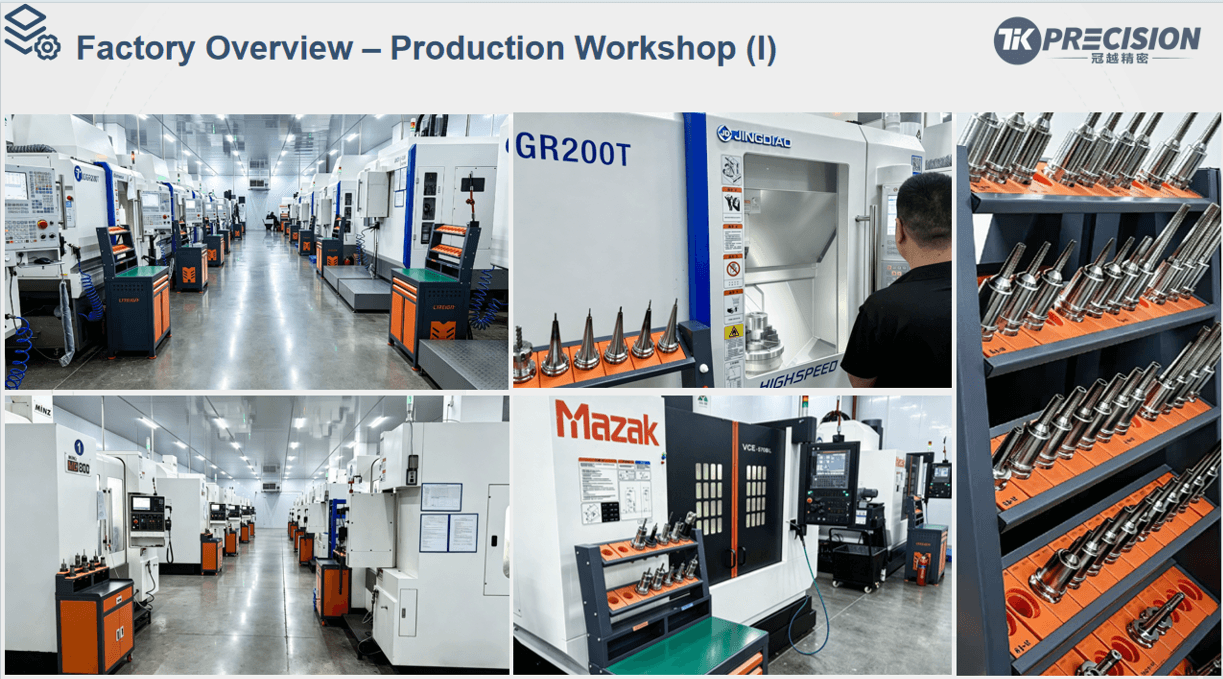
TikPrecision provides precision CNC machining for complex metal components across multiple industries, including applications where tight tolerances, complex geometry, and detailed inspection are required.
Depending on the component and engineering requirements, manufacturing capabilities may include:
- 3-axis CNC machining
- 4-axis CNC machining
- 5-axis CNC machining
- CNC turning
- Mill-turn machining
- Complex surface machining
- DFM review
- Surface finishing
- CMM inspection
- Prototype manufacturing
- Low-volume production
For aerospace prototype components, the manufacturing strategy should be developed around the actual:
CAD geometry + material + tolerance + GD&T + quantity + inspection requirements
rather than simply selecting the largest or most advanced machine available.
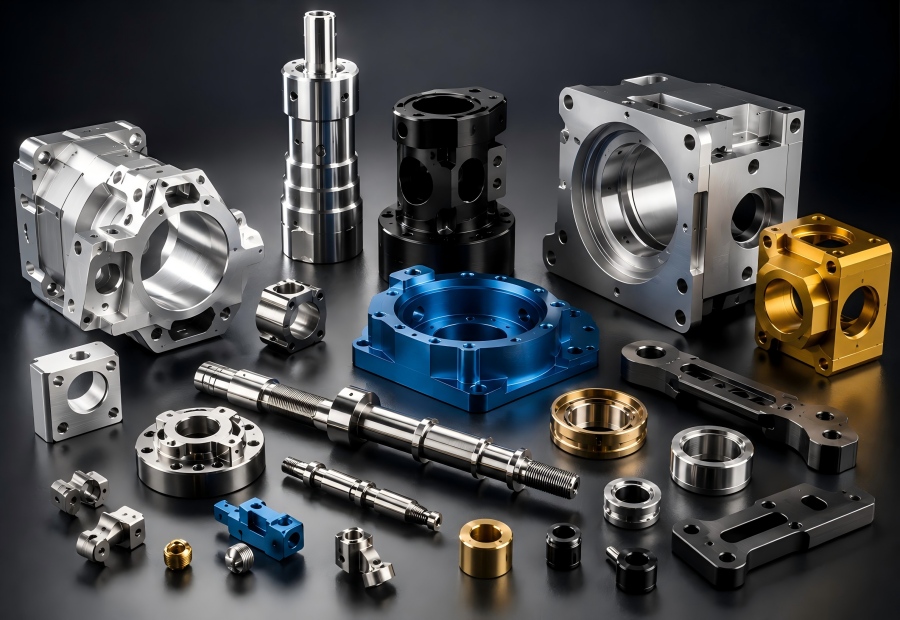
This approach can be applied to components such as:
- Aerospace brackets
- Housings
- Mounting components
- Structural prototypes
- Turbomachinery components
- Blades and vanes
- Sensor housings
- Test fixtures
- Complex machined components
17. Prototype to Low-Volume Production
One advantage of choosing the right CNC milling supplier early is the possibility of continuing the relationship after prototype validation.
A typical aerospace development cycle may look like:
Prototype → Functional Testing → Design Revision → Second Prototype → Qualification → Low-Volume Production
If the supplier understands the original manufacturing process, moving to the next stage can be easier.
Ask your supplier:
“If our prototype passes testing, can you manufacture the next revision and support low-volume production?”
This question is especially important for aerospace programs where design iterations can continue over an extended development period.
Aerospace CNC Machining Supplier Checklist
Before selecting a supplier, verify:
- Aerospace prototype experience
- Appropriate 5-axis machining capability
- Experience with your specific alloy
- Complex-surface machining capability
- DFM engineering review
- CMM inspection
- GD&T inspection
- Material traceability
- FAI capability when required
- Applicable quality certifications
- Prototype capability
- Low-volume production capability
- Realistic lead time
- Clear communication
- Documented non-conformance process
Frequently Asked Questions
Which CNC milling company is best for aerospace prototypes?
There is no universally best CNC milling company. The right supplier depends on the aerospace component’s geometry, material, tolerance, quantity, inspection requirements, certification requirements, and production stage.
Can 5-axis CNC machining achieve aerospace-grade tolerances?
Yes, 5-axis CNC machining can support tight aerospace tolerances, but the achievable result depends on the entire manufacturing process—not the machine alone. CAM programming, tooling, fixturing, thermal stability, material, and inspection all affect final accuracy.
What materials are commonly CNC machined for aerospace prototypes?
Common materials include aluminum alloys, titanium, stainless steels, and nickel-based superalloys such as Inconel. The appropriate supplier should have demonstrated experience with the specific alloy required by the project.
Do aerospace prototypes require AS9100 certification?
Not every aerospace prototype requires the supplier to hold AS9100 certification. The requirement depends on the customer’s quality system, contract, program, and applicable specifications. If certification is required, verify that it covers the actual manufacturing facility.
Does an aerospace prototype require AS9102 FAI?
Not necessarily. AS9102 FAI may be required by the customer or program specification. Confirm the requirement before production.
Should I require CMM inspection?
For complex aerospace prototype parts with tight tolerances or critical GD&T, CMM inspection can provide valuable dimensional verification. The inspection scope should be based on the drawing and customer requirements.
How do I get a quote for a tight-tolerance aerospace prototype?
Send the supplier your 3D CAD model, 2D drawing, material, quantity, tolerance/GD&T requirements, surface finish, inspection requirements, certification requirements, and target delivery date.
Conclusion: Look Beyond the CNC Machine
Choosing a CNC milling company for a tight-tolerance aerospace prototype is ultimately a process-qualification decision, not simply a machine-shopping decision.
The supplier should be able to demonstrate:
Engineering capability
→ CAM programming
→ Appropriate CNC machining
→ Process control
→ Dimensional inspection
→ Traceability
→ Documentation
→ Repeatability
The best supplier is not necessarily the company advertising the smallest tolerance or the largest machine.
It is the company that can explain:
How will you manufacture this specific aerospace prototype, how will you control the critical features, and how will you prove that the finished part meets the drawing?
For engineers, that answer demonstrates manufacturing competence.
For procurement teams, it demonstrates supplier reliability.
And for aerospace development programs, it can make the difference between a prototype that simply looks correct and one that is actually ready for meaningful engineering testing.
Need Tight-Tolerance Aerospace Prototype Parts?
Have an aerospace prototype that requires 5-axis CNC machining, complex geometry, tight tolerances, difficult materials, or detailed inspection documentation?
Send your 3D CAD model and 2D engineering drawing to TikPrecision.
Our engineering team can review:
- Part geometry
- Material
- Critical tolerances
- GD&T
- Machining strategy
- Inspection requirements
- Surface finishing
- Prototype quantity
Request a Quote
Get a quotation based on your actual engineering requirements.
Send Your Drawing
Submit your CAD model and drawing for technical review.
Request a DFM Review
Identify potential machining and tolerance issues before production begins.