Compressors are the heart of countless industrial systems — from the turbocharger in a sports car to the multistage centrifugal compressor moving natural gas across continents. The rotating components inside compressors — impellers, rotors, shafts, and seals — operate at extreme speeds under punishing loads. A single manufacturing defect can lead to catastrophic failure. Precision CNC machining is not just the preferred method for producing compressor components — for high-performance applications, it is the only method capable of meeting the required tolerances and material integrity standards.
Precision Capabilities for Compressor Engineering
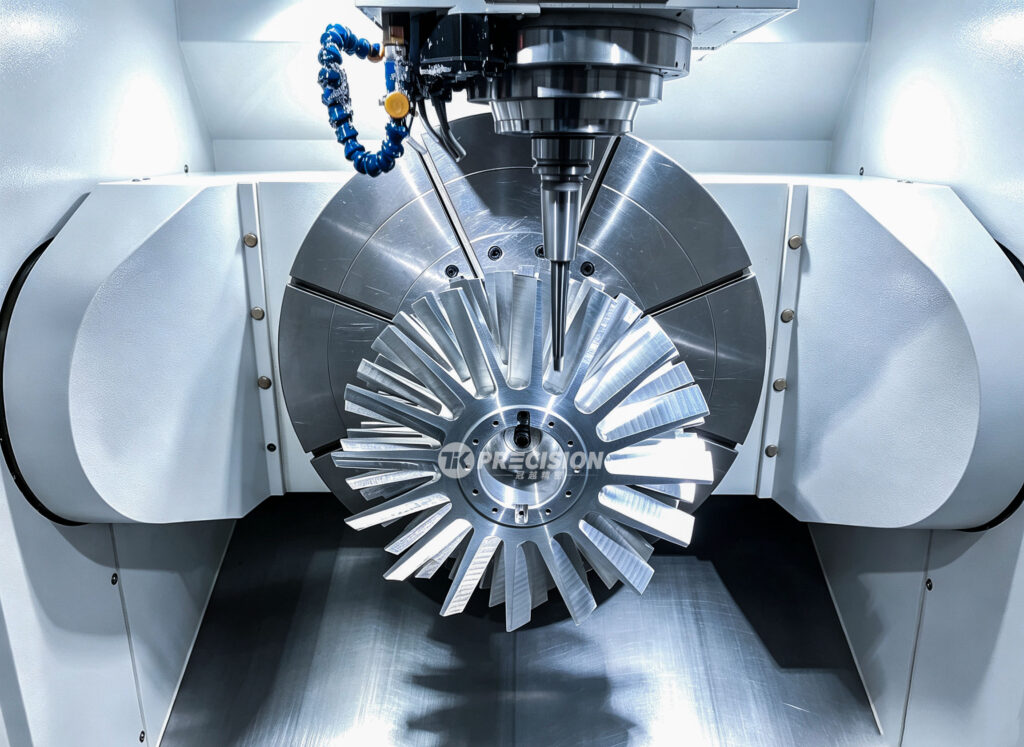
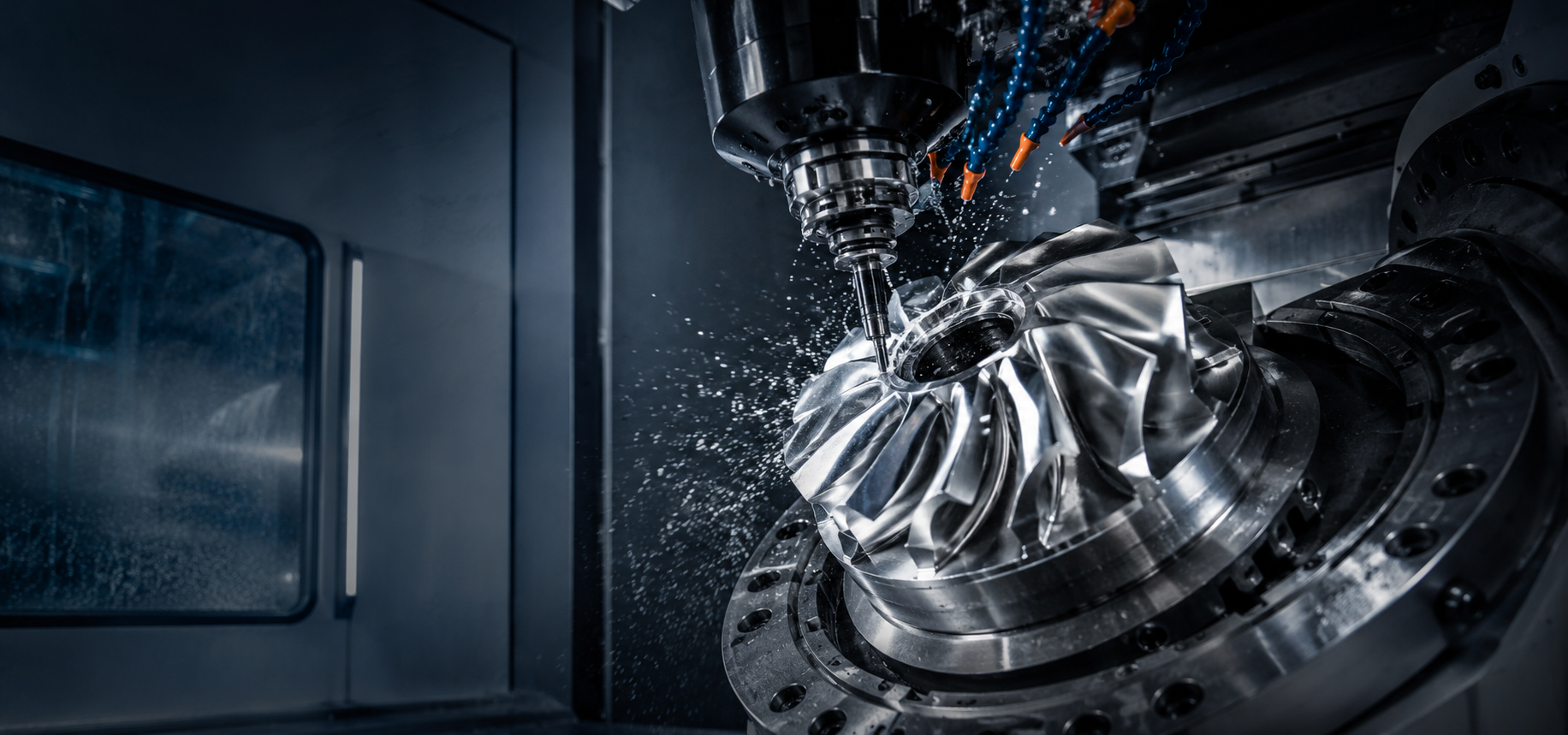
At Tik Precision, we push the boundaries of manufacturing to meet the most demanding specifications. Our advanced 5-axis CNC centers achieve positional tolerances as tight as 0.002mm, ensuring perfect alignment for high-speed rotating assemblies. Furthermore, our specialized tooling and vibration-control techniques allow us to machine ultra-thin wall sections down to 0.05mm, critical for lightweight aerospace impellers and high-sensitivity pressure diaphragms.
Types of Compressors and Their Machining Requirements
Centrifugal Compressors
Used in oil & gas, petrochemical, air separation, and HVAC industries. Gas is accelerated radially outward by a rotating impeller, converting kinetic energy to pressure in a stationary diffuser.
- Impellers: Open, semi-open, or closed designs, typically 100-800 mm diameter. Machined from 17-4 PH, 15-5 PH, or 410 stainless steel (air and inert gas service), or Inconel 625/718 (corrosive or high-temperature service). 5-axis simultaneous machining is essential for closed impellers with shrouded blades.
- Diaphragms and diffusers: Stationary components that convert velocity to pressure. Complex internal passage geometries machined from stainless steel or nodular iron castings.
- Shafts: Long, slender shafts (sometimes 3+ meters) machined from 4140, 4340, or 17-4 PH. Multiple impeller mounting diameters must be concentric within 0.01 mm TIR. Bearing journals are ground to IT4-IT5 tolerances.
Reciprocating Compressors
Used for high-pressure applications (100-1,000 bar) — natural gas compression, hydrogen compression, and industrial gas bottling.
- Cylinders and liners: Large cast iron or ductile iron components machined for piston bore diameter (honed for surface finish and cross-hatch pattern), valve pockets, and sealing surfaces.
- Pistons and piston rods: Aluminum or cast iron pistons with ring grooves precision-turned to tight tolerances. Piston rods are hard-chrome plated alloy steel, ground to precise diameters with surface finish Ra ≤ 0.2 µm.
- Valves: Plate valves, ring valves, or poppet valves with precision-lapped sealing surfaces. Valve seats and guards machined from stainless steel or thermoplastic (PEEK for high-temperature).
- Crossheads and connecting rods: Large structural components machined from cast steel or ductile iron. Bearing bores are bored or honed for precise bearing fit.
Screw Compressors
Used for medium-pressure industrial air and process gas compression. Two intermeshing helical rotors compress gas trapped between the rotor lobes and the housing.
- Male and female rotors: Complex helical profiles with tight lobe-to-lobe clearance (typically 0.03-0.08 mm). Produced by dedicated rotor grinding machines using form grinding wheels dressed to the precise rotor profile. The profile accuracy directly affects compressor efficiency.
- Housing bores: Intersecting cylindrical bores that house the rotor pair. Bored on CNC horizontal boring mills or machining centers. The bore center distance and parallelism determine rotor-to-housing clearance.
- Bearing housings and seal chambers: Precision-bored features that locate the rotor shaft bearings and shaft seals. Concentricity to the rotor bore is critical.
Turbocharger Compressors
Compact, high-speed centrifugal compressors driven by an exhaust gas turbine. Rotational speeds of 100,000-250,000 RPM are common in automotive applications.
- Compressor wheels: Machined from 7075-T6 or 2618 aluminum forgings. Five-axis simultaneous machining with impeller-specific CAM modules. Blade thickness as thin as 0.4 mm at the tip. Dynamic balancing to G2.5 or G1 at operating speed.
- Turbine wheels: Investment cast Inconel 713C for production; CNC-machined titanium for high-performance motorsport applications. The shaft bore is precision-ground for the interference fit with the shaft.
- Bearing housings: Cast iron or aluminum housings machined for journal bearing bores, thrust bearing surfaces, and oil feed passages. Bearing bore concentricity and clearance control determine rotordynamic stability.
Critical Machining Challenges for Compressor Components
Rotordynamic Considerations
Compressor rotors operate at high speeds where rotordynamics — the interaction of shaft flexibility, bearing stiffness, and unbalance forces — determines whether the machine runs smoothly or shakes itself apart. Manufacturing precision directly affects rotordynamic behavior:
- Balance quality: ISO 1940 G2.5 is typical for industrial compressors; G1 or G0.4 for high-speed and process-critical machines. Multiplane balancing is required for rotors with multiple impellers.
- Journal concentricity: Eccentricity between bearing journals excites synchronous vibration. The machining datum must be carefully established.
- Impeller fit: The interference fit between impeller bore and shaft determines the rotor’s bending stiffness. Bore tolerance of IT6 is typical, machined in a single setup with the impeller’s locating face.
Clearance Control
Compressor efficiency depends on minimizing internal leakage — gas that recirculates around impeller tips, through balance drum seals, and across interstage labyrinths:
- Impeller tip clearance: The gap between impeller blade tips and the stationary shroud must be minimized without risking rub. For a 400 mm impeller, tip clearance of 0.3-0.5 mm is typical. Both the impeller OD and the shroud ID are machined to tight tolerances.
- Labyrinth seal teeth: Thin, sharp-edged ridges machined on the shaft or stationary seal components. Tooth tips must be concentric and sharp — a rounded or eccentric tooth dramatically increases leakage.
- Balance drum clearance: The radial clearance between the balance drum and its stationary bushing controls axial thrust. Clearance of 0.2-0.4 mm is typical, requiring IT6 machining on both components.
Materials for Compressor Machining
| Material | Typical Application | Machining Notes |
|---|---|---|
| 17-4 PH (H1150) | Centrifugal impellers, shafts | Machine in solution-annealed condition, then age-harden. Dimensional stability during aging must be accounted for |
| 15-5 PH (H1150) | Compressor impellers (superior transverse toughness vs 17-4) | Similar to 17-4 PH; preferred for larger impellers where transverse properties matter |
| 410 / CA6NM Stainless | Steam turbine and compressor blading | Martensitic stainless with good machinability. Heat treatable for hardness and strength |
| Inconel 718 | High-temperature compressor impellers, turbocharger turbine wheels | Extremely difficult to machine. Requires CBN or ceramic tooling, rigid setups, low speeds. Age-hardening after machining for final properties |
| 4140 / 4340 Alloy Steel | Compressor shafts, coupling hubs | Good machinability in annealed condition. Heat treat to required strength, then grind bearing journals |
| 7075-T6 Aluminum | Turbocharger compressor wheels, low-pressure blowers | Excellent machinability. Stress-relieved billet (T651) recommended for thin-bladed impellers |
Tik Precision provides CNC machining for compressor components — impellers, shafts, seal components, and housings. Our 5-axis machining capability and experience with compressor alloys support applications from industrial process compression to high-performance turbochargers. Contact us to discuss your compressor machining requirements.