The Role of 5-Axis Machining in Modern Turbine Manufacturing
5-axis CNC machining has become a critical manufacturing technology for producing today’s most demanding aerospace turbine components. From complex turbine blades and guide vanes to integrally bladed rotors (IBRs/blisks), modern aero-engine parts require exceptional accuracy, surface quality, and geometric consistency that traditional machining methods cannot achieve.
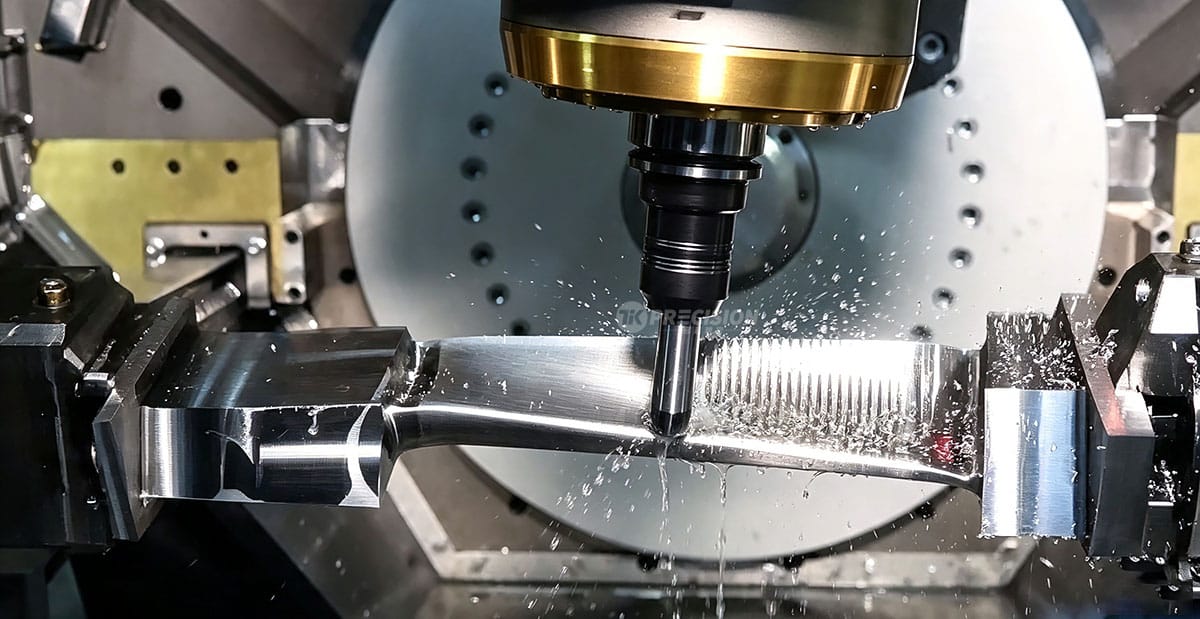
Unlike conventional 3-axis machining, simultaneous 5-axis machining enables continuous control of the cutting tool orientation relative to the workpiece. This capability allows manufacturers to precisely machine complex freeform geometries—including twisted airfoils, variable-thickness blade profiles, and contoured aerodynamic surfaces—while maintaining optimal cutting conditions throughout the process.
For aerospace OEMs and Tier 1 suppliers, 5-axis machining is not simply an advanced manufacturing option; it is a fundamental technology for achieving the performance, reliability, and repeatability required in next-generation turbine systems.
Why 5-Axis CNC Machining Is Essential for Turbine Parts
Aerospace turbine components are among the most challenging parts to manufacture due to their complex aerodynamic designs and demanding material requirements.
Components such as:
- Turbine blades
- Compressor blades
- Guide vanes
- Blisks (integrally bladed rotors)
- Turbine casings
typically contain continuously changing curvature, tight dimensional tolerances, thin-wall structures, and difficult-to-machine materials such as titanium alloys and nickel-based superalloys.
Traditional 3-axis machining requires multiple setups and manual repositioning to access different areas of the component. These additional operations increase the risk of:
- Part positioning errors
- Surface mismatch between machining operations
- Longer production cycles
- Reduced geometric accuracy
Simultaneous 5-axis machining eliminates many of these limitations by allowing the cutting tool to continuously adjust its orientation during machining.
Key advantages include:
Continuous Tool Orientation Control
The cutting tool maintains an optimized angle relative to the blade or airfoil surface, following the changing surface normal throughout the machining process.
This results in:
- More consistent cutting conditions
- Improved surface finish quality
- Reduced tool deflection
- Better control of complex aerodynamic profiles
Single-Setup Machining Capability
5-axis machining allows multiple features to be completed in a single fixture setup, significantly reducing:
- Fixture-related alignment errors
- Manual handling requirements
- Accumulated positional deviation
For high-value aerospace components, minimizing part repositioning is essential for maintaining dimensional accuracy and process repeatability.
Machining Complex Features and Difficult Geometries
Advanced 5-axis machining provides access to areas that are difficult or impossible to reach with conventional methods, including:
- Blade root transitions
- Tight fillet regions
- Undercut geometries
- Deep concave surfaces
- Complex internal contours
This capability is particularly important for modern turbine designs where aerodynamic efficiency depends on highly optimized surface geometry.
Key Technical Factors in 5-Axis Turbine Machining
Achieving aerospace-level machining performance requires more than a five-axis machine tool. It requires advanced programming strategies, accurate process control, and deep experience with difficult aerospace materials.
Advanced Toolpath Planning
The quality of a turbine component largely depends on the effectiveness of the toolpath strategy.
Common approaches include:
- Constant scallop machining
- Flow-line machining
- Parametric surface machining
- Adaptive toolpath strategies
These techniques are optimized to balance:
- Surface finish requirements
- Material removal efficiency
- Tool engagement stability
- Overall machining cycle time
For turbine blades and blisks, carefully optimized toolpaths help maintain consistent surface quality across highly curved aerodynamic surfaces.
Tool Axis Vector Management
In simultaneous 5-axis machining, controlling tool lead and tilt angles is critical.
Proper tool axis management helps:
- Prevent tool collisions
- Maintain stable cutting forces
- Reduce vibration
- Extend cutting tool life
Incorrect tool orientation can lead to poor surface quality, excessive tool wear, or even damage to expensive aerospace components.
Machine Kinematics and Post-Processor Accuracy
Different 5-axis machine configurations—including:
- Trunnion-table machines
- Swivel-head machines
- Hybrid configurations
have different rotary axis movements and kinematic characteristics.
Accurate post-processing and machine calibration are essential to ensure that programmed toolpaths are accurately translated into real machine motion.
For aerospace applications, advanced CNC simulation and verification are commonly used before machining begins to eliminate collision risks and optimize production reliability.
Cutting Parameter Optimization for Difficult Materials
Aerospace turbine components are commonly manufactured from challenging materials including:
- Titanium alloys (Ti-6Al-4V)
- Nickel-based superalloys (Inconel 718, Rene alloys)
- High-temperature stainless steels
These materials require carefully optimized machining parameters to control:
- Heat generation
- Tool wear
- Work hardening
- Cutting forces
Proper selection of cutting speed, feed rate, and depth of cut directly impacts tool life, surface integrity, and production consistency.
Common Challenges in Aerospace Turbine Machining
Thin-Wall Vibration and Chatter Control
Many turbine blades and vanes feature lightweight, thin-wall structures designed for maximum aerodynamic efficiency.
However, these geometries are naturally flexible and susceptible to vibration during machining.
Manufacturers address this challenge through:
- Optimized fixturing strategies
- Reduced cutting engagement
- Stable toolpath planning
- Spindle speed optimization
Effective chatter control is essential for achieving the required surface finish and dimensional accuracy.
Tool Wear Management in Superalloy Machining
Nickel-based superalloys provide excellent high-temperature performance but are extremely difficult to machine.
Their characteristics include:
- High cutting temperatures
- Work-hardening behavior
- Strong abrasive properties
Successful machining requires:
- Advanced cutting tool coatings
- Optimized cutting parameters
- Real-time tool wear monitoring
- Process consistency control
These factors directly influence part quality and production economics.
Digital Simulation and Collision Verification
Because aerospace turbine components are expensive and geometrically complex, machining errors can result in significant material loss and production delays.
Modern manufacturers rely on:
- Full machine simulation
- Digital twin technology
- Collision detection systems
- Virtual machining verification
before actual cutting begins.
This approach ensures safe, predictable, and repeatable production.
The Future of 5-Axis Turbine Component Manufacturing
The next generation of turbine machining is moving toward highly automated and data-driven manufacturing environments.
Emerging technologies include:
In-Process Measurement and Adaptive Machining
Integrated probing systems enable real-time measurement and automatic toolpath compensation, allowing manufacturers to correct machining deviations during production.
Digital Twin-Based Manufacturing
Digital twins combine machine data, simulation models, and process information to predict machining behavior before production.
This enables:
- Faster process optimization
- Reduced setup time
- Improved first-pass yield
Closed-Loop Manufacturing Systems
Advanced aerospace machining platforms increasingly use feedback-driven systems that automatically adjust machining parameters based on:
- Cutting force monitoring
- Tool condition data
- Measurement results
These technologies are helping manufacturers achieve tighter tolerances, higher productivity, and improved process reliability.
Conclusion: 5-Axis Machining Enables the Future of Aerospace Turbine Manufacturing
5-axis CNC machining is the foundation of modern aerospace turbine component production. Its ability to precisely control tool orientation, machine complex aerodynamic geometries, and maintain consistent surface quality makes it indispensable for manufacturing high-performance turbine blades, vanes, and blisks.
However, successful aerospace machining requires more than advanced equipment. It requires comprehensive expertise in five-axis programming, difficult material processing, precision inspection, and quality control.
Manufacturers with proven experience in 5-axis CNC machining, titanium machining, and superalloy processing are uniquely positioned to support aerospace OEMs and engineering teams demanding exceptional accuracy, repeatability, and manufacturing reliability.
5-Axis CNC Machining for Aerospace Turbine Components | Precision Blade & Blisk Manufacturing
Meta Description:
Advanced 5-axis CNC machining solutions for aerospace turbine blades, vanes, and blisks. Precision manufacturing of complex airfoil geometries using titanium and superalloy materials.
Target Keywords:
- 5 axis CNC machining aerospace
- aerospace turbine blade machining
- turbine blade CNC machining
- blisk machining
- 5 axis machining for turbine components
- aerospace precision machining
- superalloy CNC machining
- titanium aerospace machining
- turbine component manufacturer