A Practical Guide to Precision Impeller Machining, 5-Axis CNC Manufacturing, and Supplier Selection
Turbomachinery impellers are among the most challenging components to manufacture with precision CNC machining.
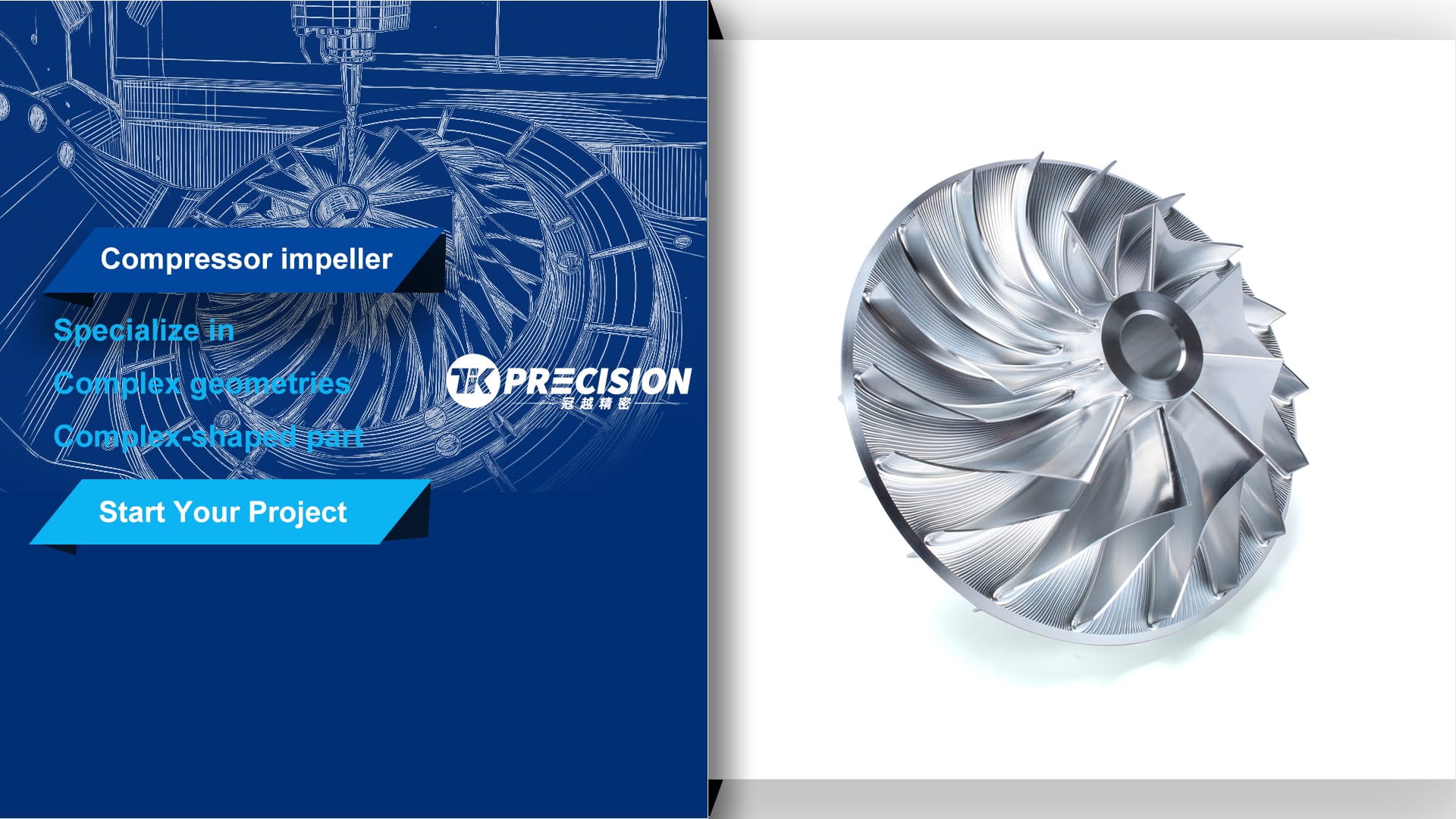
Used in aerospace engines, gas turbines, turbochargers, centrifugal compressors, pumps, cryogenic equipment, and other high-speed rotating systems, impellers combine complex three-dimensional blade geometry with demanding dimensional, surface-finish, and balancing requirements.
The manufacturing challenge becomes even greater when the part is made from difficult-to-machine materials such as Inconel, titanium, 17-4 PH stainless steel, or other high-strength alloys.
For engineers and procurement professionals sourcing custom impellers, the real question is not simply:
“Can this supplier machine an impeller?”
The more important questions are:
- Can the supplier machine our specific impeller geometry?
- Can it achieve the required tolerances consistently?
- Does it have experience with our specific material?
- Can it inspect complex blade geometry?
- Can it provide dimensional and material documentation?
- Can it support dynamic balancing when required?
- Can it provide engineering and DFM support before production?
This guide reviews notable manufacturers of precision-machined turbomachinery components and explains how to evaluate an impeller machining supplier based on 5-axis capability, materials, inspection, balancing, engineering support, production capacity, and quality systems.
Quick Answer: What Should You Look for in an Impeller Machining Supplier?
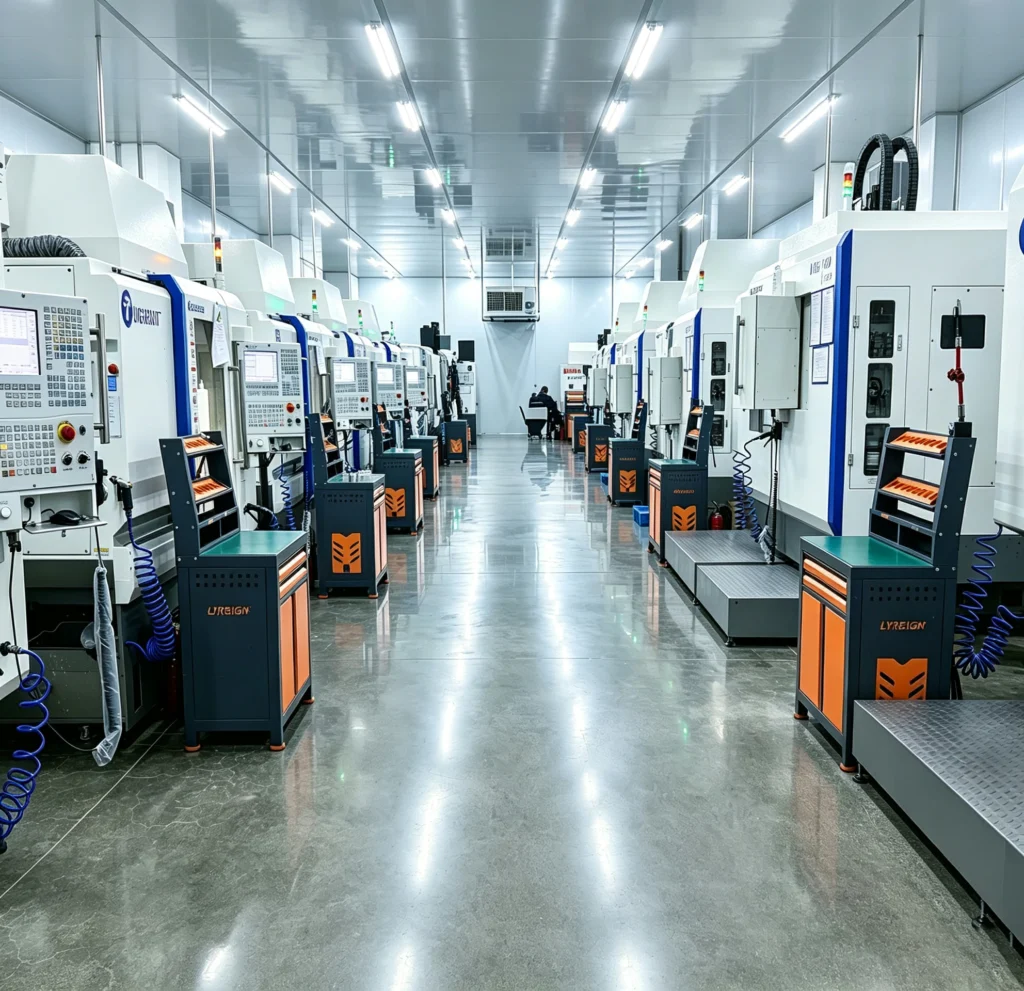
For complex turbomachinery impellers, a capable supplier should be able to demonstrate some or all of the following capabilities, depending on the project:
| Capability | Why It Matters |
|---|---|
| Simultaneous 5-axis CNC machining | Enables efficient machining of complex blade surfaces |
| Advanced CAM programming | Controls tool orientation and blade-surface accuracy |
| Complex impeller experience | Reduces manufacturing and programming risk |
| Difficult-material experience | Important for titanium, Inconel, and hardened alloys |
| CMM inspection | Verifies critical dimensions and geometry |
| GD&T inspection | Confirms positional and geometric requirements |
| Dynamic balancing | Important for high-speed rotating components |
| Material traceability | Required for many aerospace and industrial applications |
| DFM review | Identifies machining problems before production |
| FAI documentation | Supports first-article qualification when required |
| Prototype and low-volume production | Important for development programs |
Important: No single machine, tolerance specification, or certification guarantees impeller quality. The actual manufacturing capability depends on the part geometry, material, size, tolerance, machining strategy, inspection method, and production requirements.
Part I: Why Precision Impeller Machining Is So Difficult
1. Complex 3D Blade Geometry
One of the biggest challenges in impeller machining is the blade geometry.
Impeller blades are often designed using aerodynamic or hydrodynamic calculations and can contain:
- Three-dimensional twisted surfaces
- Variable blade thickness
- Curved leading and trailing edges
- Complex hub transitions
- Narrow flow passages
- Undercut areas
- Variable blade angles
- Tight blade-to-hub relationships
These features are fundamentally different from conventional prismatic CNC components.
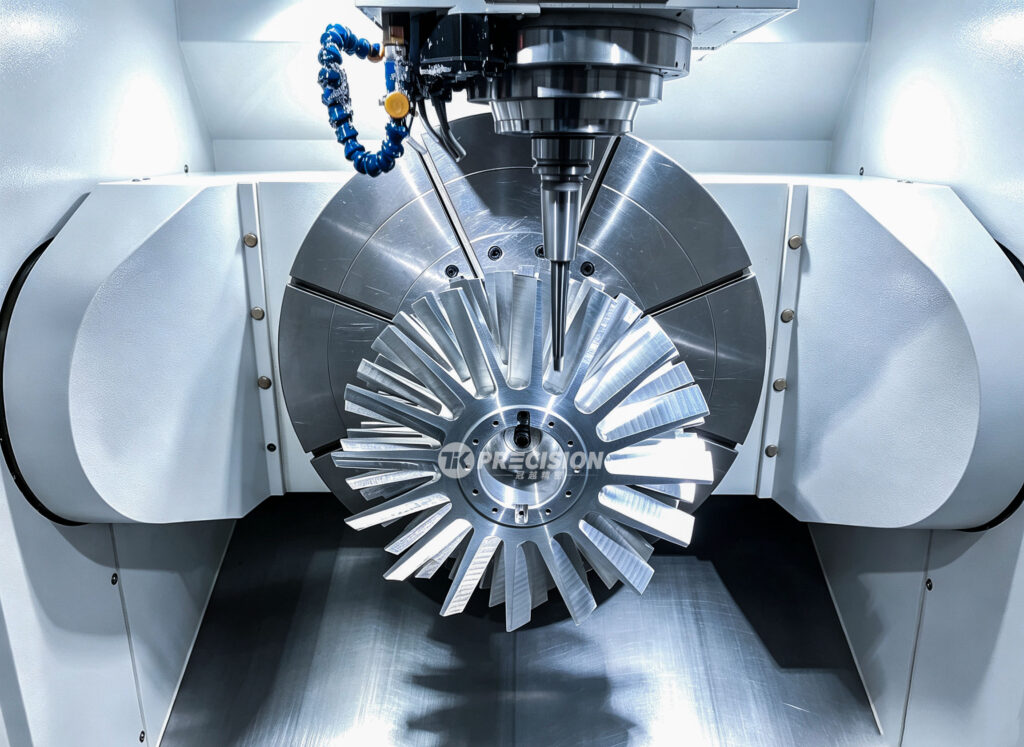
For many complex impellers, simultaneous 5-axis CNC machining can provide significant advantages because the cutting tool can continuously change orientation while following the blade surface.
This can help reduce:
- Multiple setups
- Setup-related variation
- Tool interference
- Excessive tool overhang
- Difficult access to blade surfaces
However, it is important to distinguish between true simultaneous 5-axis machining and 3+2 positioning.
A supplier having a machine with five axes does not automatically mean it has the process capability required for complex impeller manufacturing.
2. Tight Tolerances and Complex GD&T
Impeller drawings may contain tight dimensional and geometric requirements.
Typical critical characteristics can include:
- Blade profile
- Blade thickness
- Hub dimensions
- Bore diameter
- Concentricity
- Runout
- Position
- Profile
- Surface finish
- Balance requirements
The original article gives examples such as blade-profile tolerances in the ±0.02 mm to ±0.005 mm range, with surface-finish and concentricity requirements also specified for demanding applications.
However, these values should be treated as application-specific examples rather than universal impeller machining standards.
A better approach is to determine tolerance requirements from:
- Operating speed
- Fluid-dynamic performance
- Assembly requirements
- Bearing and shaft interfaces
- Material
- Part size
- Manufacturing process
- Inspection method
The goal is not to make every dimension as tight as possible.
The goal is to make every functionally critical dimension as accurate as necessary.
3. Surface Finish Can Affect Performance
Surface finish is particularly important for impellers because blade surfaces interact directly with moving gas or liquid.
Depending on the application, surface condition can influence:
- Fluid flow
- Efficiency
- Turbulence
- Friction
- Cavitation behavior
- Fatigue performance
- Cleaning requirements
The required surface finish should therefore be specified according to the engineering requirements of the final application.
For some impellers, CNC machining can produce the required finish directly.
For others, additional processes may be required, such as:
- Polishing
- Grinding
- Vibratory finishing
- Manual finishing
- Blasting
- Coating
A supplier should explain how the required surface finish will be achieved, rather than simply stating a maximum Ra value.
4. Material Is a Major Manufacturing Variable
Impeller materials often need to withstand high temperature, high rotational speed, pressure, corrosion, or demanding operating environments.
The original article identifies several common material families, including Inconel, titanium, stainless steel, and aluminum alloys.
Inconel
Common grades include:
- Inconel 625
- Inconel 718
Typical applications include:
- Aerospace
- Gas turbines
- High-temperature turbomachinery
Machining challenges include:
- High cutting forces
- Work hardening
- Heat concentration
- Tool wear
Titanium
Common grades include:
- Ti-6Al-4V
- Grade 5
Titanium is widely used where high strength-to-weight ratio is important.
The main machining challenges include:
- Low thermal conductivity
- High cutting temperatures
- Tool wear
- Deflection
Stainless Steel
17-4 PH and other stainless steels can be used in pumps, compressors, and industrial rotating equipment.
Machining strategy must account for:
- Material condition
- Hardness
- Work hardening
- Cutting forces
- Heat generation
Aluminum
6061 and 7075 are widely used for:
- Prototypes
- Turbocharger components
- Test equipment
- Lower-temperature applications
Aluminum is relatively easy to machine, although thermal expansion can become important when tight tolerances are required.
5. Shrouded vs. Unshrouded Impellers
Impeller configuration is another major factor when selecting a machining supplier.
Unshrouded Impellers
Unshrouded or open impellers generally provide better tool access.
They may be used for:
- Pumps
- Compressors
- Turbochargers
- Experimental turbomachinery
Their open geometry can make them more accessible to multi-axis CNC machining.
Shrouded Impellers
Shrouded or closed impellers are significantly more challenging.
The blades are enclosed between the hub and shroud, creating restricted flow passages.
This can create challenges involving:
- Tool access
- Tool-holder interference
- Small-diameter cutters
- Tool deflection
- CAM programming
- Collision avoidance
- Surface finish
The original article correctly highlights shrouded impellers as a separate manufacturing challenge requiring specialized 5-axis strategies and, in some cases, custom tooling.
When requesting a quotation, always tell the supplier whether your part is:
Open / Unshrouded
or
Closed / Shrouded.
Part II: Notable Manufacturers for Precision Impeller Machining
The following companies are examples of manufacturers associated with precision turbomachinery and impeller-related manufacturing.
This is not a ranking.
Supplier suitability depends on the specific application, geography, material, part size, certifications, production quantity, and technical requirements.
1. Turbo Machined Products — USA
Turbo Machined Products is associated with precision machining of complex turbomachinery components.
Capabilities
- 5-axis machining
- Reverse engineering
- CNC turning
- CMM inspection
- Turbomachinery component manufacturing
Materials
Reported capabilities include:
- Inconel
- Titanium
- Monel
- Aluminum
- Stainless steel
Components
- Turbine blades
- Vanes
- Impellers
- Blisks
The company is positioned toward demanding aerospace, defense, power-generation, marine, and other precision applications. The source material identifies AS9100 certification and machining capability around 0.001 in. tolerance for components.
2. Solid Machine — USA
Solid Machine specializes in precision machining of rotating and bladed turbomachinery components.
Capabilities
- CNC turning
- Simultaneous 5-axis milling
- Complex rotating hardware
- Prototype manufacturing
- Production machining
Components
- Turbocharger impellers
- Axial impellers
- Radial impellers
- Turbine components
- Compressor components
- Blades
- Vanes
The supplied source describes machining capacity up to approximately Ø650 mm and production ranging from prototypes to higher-volume manufacturing.
3. Greno Industries — USA
Greno Industries focuses on precision machining of demanding alloys used in severe-service applications.
Capabilities
- CNC milling
- CNC turning
- Multi-axis machining
- CMM inspection
- Material traceability
- NDT
Materials
Examples include:
- Nitronic 50/60
- Duplex 2205
- Super Duplex 2507
- Hastelloy
- Inconel 718
- Monel K-500
Applications
- Pumps
- Fluid-handling equipment
- Rotating machinery
- Industrial replacement components
The source also identifies AS9100 and ISO 9001 certification and material traceability capabilities.
4. Paragon Precision — USA
Paragon Precision has decades of experience in precision machining.
Capabilities
- 5-axis machining
- Multi-spindle milling
- Grinding
Turbomachinery Components
- Impellers
- Blisks
- Stators
- Diffusers
- Compressor blades
- Turbine blades
- Vanes
The company’s long operating history and turbomachinery experience make it a relevant supplier to evaluate for complex precision components.
5. NuCon Corporation — USA
NuCon Corporation specializes in complex CNC-machined components.
Components
- Large-diameter impellers
- Shrouded impellers
- Steam turbine nozzles
Industries
- Aerospace
- Aircraft
- Turbomachinery
- Chemical
- Petrochemical
- Oil & gas
Its experience with large and complex components can be relevant for applications where work envelope is a major consideration.
6. Richter Präzisionstechnik — Germany
Richter Präzisionstechnik focuses on high-precision machining using high-speed cutting technology.
Applications
- Pumps
- Turbines
- Compressors
- Complex rotating components
The supplied source highlights its ability to support both individual components and series production.
7. Kagoshima Seiki — Japan
Kagoshima Seiki has demonstrated simultaneous 5-axis machining for complex impeller geometries.
The supplied information specifically identifies:
- Simultaneous 5-axis machining
- Brother M200Xd1-5AX equipment
- Aluminum 6061 machining
The source also highlights the company’s demonstrated surface-finish performance on complex impeller geometries.
8. AIKOKU ALPHA — Japan
AIKOKU ALPHA has substantial five-axis machining capacity.
Capabilities
- Simultaneous 5-axis machining
- Complex impeller machining
- Advanced CAM programming
The source describes a large five-axis machining capacity and software systems used for impeller modeling.
9. Kobelco — Japan
Kobelco has developed machining and NC programming techniques for three-dimensional impeller blade geometries.
One of the key benefits of optimized programming is the potential to reduce machining time while maintaining the required blade geometry.
This becomes increasingly important as:
- Blade count increases
- Geometry becomes more complex
- Flow passages become narrower
- Production volume increases
The source specifically identifies five-axis simultaneous machining and proprietary NC programming methods.
10. Other Turbomachinery Manufacturers to Consider
The original article also identifies several additional companies:
| Manufacturer | Region | Area of Interest |
|---|---|---|
| Howmet Aerospace | Global | Aerospace engine components |
| Bescast | USA | Investment casting + machining |
| FlowDy | Korea | Turbine components |
| JINYOUNG TBX | Korea | Blades, VSVs, impellers |
| TCT | Korea | Compressor wheels, impellers, blisks, diffusers |
These companies should not be treated as interchangeable suppliers.
Some focus heavily on aerospace or large-scale production, while others may be more relevant to specialized turbomachinery or component manufacturing.
Part III: How to Evaluate an Impeller Machining Manufacturer
Finding manufacturers is only the first step.
The more important task is determining whether a supplier can actually manufacture your specific impeller.
1. Verify True 5-Axis Capability
Not all five-axis machining is the same.
Ask the supplier:
- What five-axis machines do you operate?
- Do you perform simultaneous 5-axis machining?
- Do you also use 3+2 machining?
- What is the maximum workpiece diameter?
- What is the maximum workpiece weight?
- What type of impellers have you previously machined?
The original article emphasizes the difference between simultaneous five-axis machining and 3+2 positioning.
For complex blade geometry, this distinction can be critical.
2. Verify Material Experience
Do not ask only:
“Can you machine titanium?”
Ask:
“Have you machined this alloy, in a similar impeller geometry, at this size and tolerance?”
This is a much better qualification question.
Ask for:
- Similar project examples
- Typical tool strategy
- Surface-finish results
- Typical tolerance capability
- Expected cycle time
- Tool-life considerations
The original article correctly emphasizes that Inconel, titanium, and 17-4 PH require different tooling, cutting parameters, and coolant strategies.
3. Evaluate Inspection Capability
For tight-tolerance impellers, inspection should be discussed before production—not after the parts are finished.
Ask whether the supplier can provide:
- CMM inspection
- Dimensional inspection reports
- GD&T verification
- Surface-finish measurement
- Material certificates
- MTRs
- FAI documentation
- NDT when required
The original article lists CMM, material traceability, NDT, and FAI as important quality capabilities.
However, avoid treating every item as mandatory for every impeller.
The required inspection level should be determined by:
industry + application + drawing + customer specification + risk level.
4. Ask About Dynamic Balancing
Impellers are rotating components, so balancing can be an important part of the manufacturing process.
Ask:
- Is dynamic balancing available?
- Is it performed internally or through a qualified partner?
- What balance specification is supported?
- What standard does the project require?
- Will a balancing report be supplied?
The required balance grade should come from the engineering specification or final assembly requirements rather than being assumed universally.
5. Evaluate Production Capacity
A supplier that is excellent for one prototype may not necessarily be the right supplier for production.
Ask:
Prototype
- Can you manufacture one-off parts?
- How quickly can you complete DFM?
- How quickly can you program the part?
- What inspection documentation is available?
Low Volume
- Can you maintain repeatability?
- Can you maintain consistent tooling?
- Can you control process variation?
Production
- What is the monthly capacity?
- What is the typical cycle time?
- How is tool wear controlled?
- How are process changes documented?
The original source explicitly recommends evaluating prototype versus production lead time and capacity.
6. DFM and Engineering Support
This is one of the most overlooked supplier-selection criteria.
A good impeller manufacturer should review the CAD model before production and identify:
- Tool-access problems
- Thin-wall risks
- Deep-cavity problems
- Tool-holder interference
- Unrealistic tolerances
- Surface-finish challenges
- Difficult blade transitions
- Potential balancing issues
The original article recommends evaluating whether a supplier provides DFM feedback during quoting.
This can prevent expensive problems before machining starts.
Part IV: Regional Supplier Considerations
North America
North American suppliers may be particularly attractive for U.S. aerospace and defense programs where customers require specific quality systems, traceability, domestic manufacturing, or applicable export-control compliance.
The original source highlights companies such as Turbo Machined Products, Solid Machine, Greno Industries, and Paragon Precision in this context.
Europe
European suppliers can be attractive for:
- Precision industrial equipment
- Pumps
- Compressors
- Turbomachinery
- Aerospace
- Series production
The original article highlights German precision-machining capabilities such as Richter Präzisionstechnik.
Japan
Japanese manufacturers represented in the source include:
- Kagoshima Seiki
- AIKOKU ALPHA
- Kobelco
The source emphasizes their five-axis machining and CAM capabilities.
Korea
The source identifies:
- FlowDy
- JINYOUNG TBX
- TCT
as companies associated with turbomachinery and precision rotating components.
Part V: What Should You Send When Requesting an Impeller Machining Quote?
For an accurate quotation, provide as much engineering information as possible.
Required CAD Data
Preferably provide:
- STEP
- Parasolid
- Native CAD format when appropriate
2D Engineering Drawing
Include:
- Critical dimensions
- GD&T
- Material
- Surface finish
- Heat treatment
- Coating
- Balancing requirements
- Inspection requirements
Project Information
Also specify:
- Quantity
- Prototype or production
- Required delivery date
- Application
- Required certifications
- Inspection documentation
- Packaging requirements
Most Important:
Clearly identify the critical features.
Don’t simply write:
“Need high precision.”
Instead, identify:
Blade profile: ±0.01 mm
Bore: Ø25.000 ±0.005 mm
Surface finish: Ra 0.8 μm
Dynamic balance: according to drawing specification
This gives the manufacturer enough information to develop a realistic process and quotation.
Part VI: Red Flags When Choosing an Impeller Manufacturer
Be cautious if a supplier:
1. Promises Every Tolerance Without Reviewing the CAD
Complex impeller machining should involve engineering review.
2. Only Shows a Machine List
Owning a five-axis machine does not prove impeller expertise.
3. Cannot Explain Its Inspection Process
Ask what equipment will inspect the part and what report you will receive.
4. Has No Experience With Your Material
Machining aluminum is very different from machining titanium or Inconel.
5. Ignores Dynamic Balancing
For high-speed rotating components, balancing requirements should be discussed early.
6. Gives a Quote Without Asking Technical Questions
A professional supplier should want to understand:
- Geometry
- Material
- Quantity
- Tolerance
- Surface finish
- Inspection
- Delivery
before finalizing a quotation.
Part VII: TikPrecision — Precision CNC Machining for Complex Components
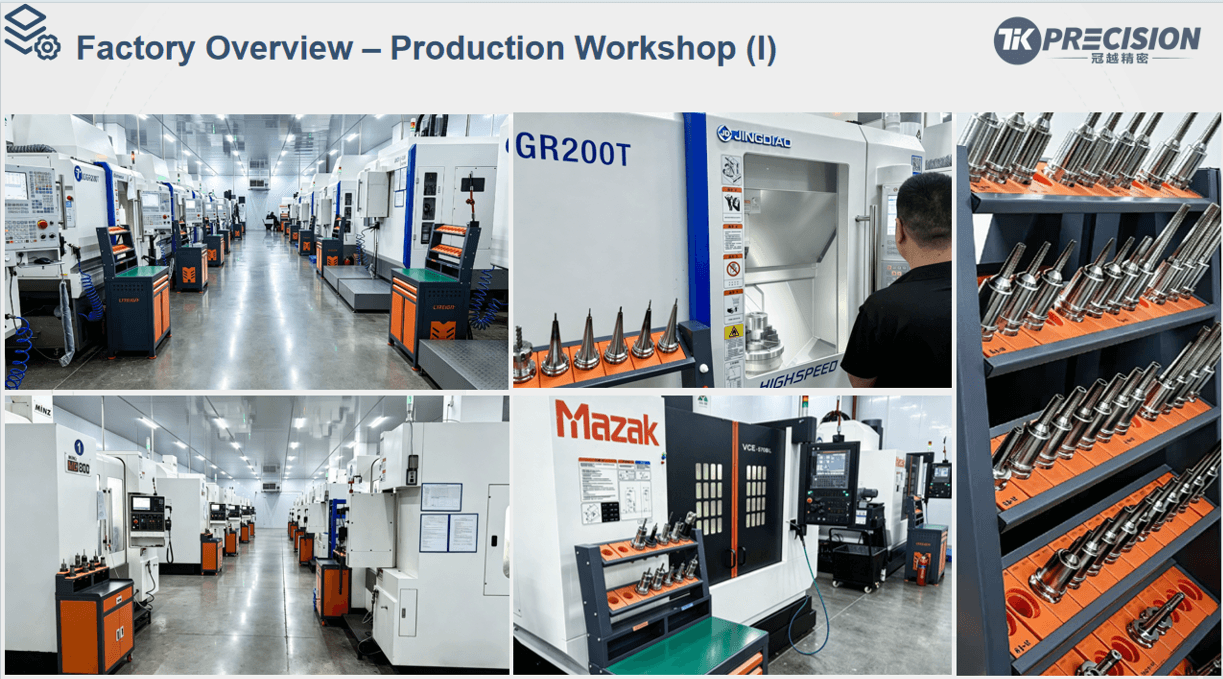
TikPrecision provides precision CNC machining for complex components across multiple industries, rather than focusing exclusively on compressor impellers.
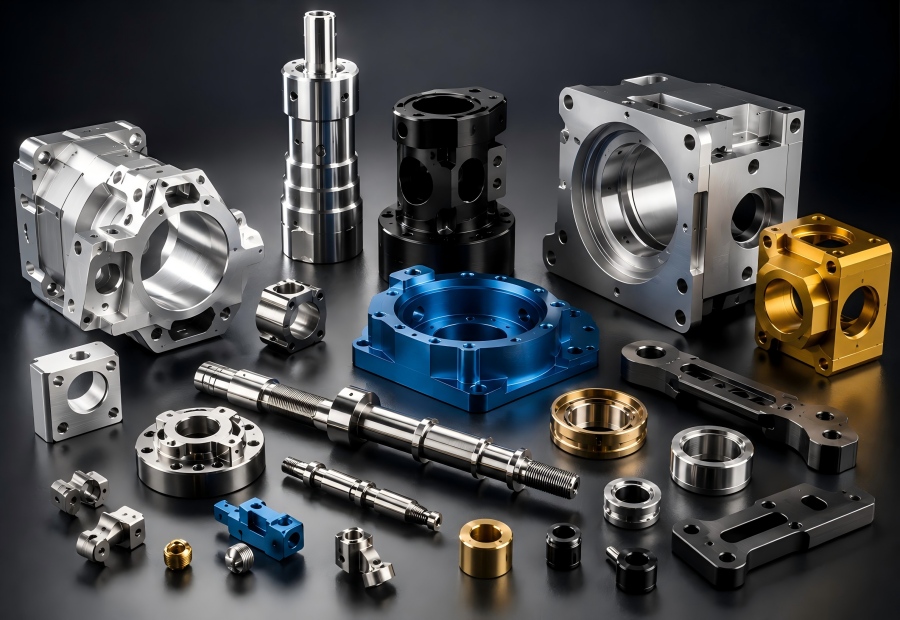
For customers requiring custom impellers, compressor components, turbine-related parts, pump components, housings, shafts, brackets, and other precision-machined metal parts, the manufacturing process should be developed around the actual engineering requirements of each component.
Depending on the project, manufacturing support can include:
- 3-axis CNC machining
- 4-axis CNC machining
- 5-axis CNC machining
- CNC turning
- Mill-turn machining
- Complex surface machining
- DFM review
- Surface finishing
- CMM inspection
- Dimensional inspection
- Prototype machining
- Low-volume production
For complex impellers, the engineering team should evaluate:
CAD geometry → material → tolerance → tooling → machining strategy → inspection → finishing → balancing
rather than relying on a generic machining process.
This approach is particularly important when the component has complex blade geometry, difficult materials, tight tolerances, or high-speed rotating requirements.
Part VIII: Impeller Manufacturer Evaluation Checklist
Before selecting a supplier, verify the following:
| Priority | Requirement |
|---|---|
| Must Have | Appropriate multi-axis CNC capability |
| Must Have | Experience with your specific material |
| Must Have | Defined inspection process |
| Must Have | Ability to meet drawing requirements |
| Should Have | CMM inspection |
| Should Have | Dynamic balancing capability |
| Should Have | DFM engineering review |
| Should Have | Material traceability when required |
| Should Have | FAI documentation when required |
| Application Dependent | AS9100 / ISO 9001 / other certifications |
| Application Dependent | NDT |
| Application Dependent | ITAR/export-control compliance |
| Nice to Have | Rapid quoting |
| Nice to Have | Prototype + production capability |
The original article’s final recommendation is particularly important: supplier qualification should evaluate process discipline, inspection rigor, material traceability, engineering engagement, and responsiveness, rather than simply comparing machine lists and prices.
Frequently Asked Questions About Precision Impeller Machining
What CNC machine is best for impeller machining?
For many complex impeller geometries, simultaneous 5-axis CNC machining provides significant advantages because the tool can continuously change orientation while following complex blade surfaces. The optimal machine depends on the impeller size, geometry, material, and tolerance requirements.
Can CNC machines manufacture shrouded impellers?
Yes. Shrouded impellers can be CNC machined, but their enclosed flow passages make tool access, collision avoidance, CAM programming, and surface finishing more challenging.
What materials are commonly used for CNC-machined impellers?
Common materials include aluminum, stainless steel, titanium, Inconel, and other engineering alloys. Material selection depends on operating temperature, pressure, corrosion resistance, rotational speed, strength, and application requirements.
How tight can CNC-machined impeller tolerances be?
There is no universal tolerance for all impellers. Achievable tolerance depends on geometry, material, machine condition, tooling, workholding, thermal stability, machining strategy, and inspection method.
Do impellers require dynamic balancing?
Many high-speed rotating impellers require dynamic balancing, but the exact requirement should be determined from the engineering drawing, operating speed, rotor design, and final assembly specification.
What inspection is recommended for precision impellers?
Depending on the application, inspection may include CMM dimensional inspection, GD&T verification, surface-finish measurement, material certification, FAI, balancing reports, and NDT.
How do I get a quote for a custom impeller?
Provide a 3D CAD model, 2D engineering drawing, material, quantity, critical tolerances, surface finish, balancing requirements, inspection requirements, and required delivery date.
Conclusion: The Best Impeller Manufacturer Is the One That Can Prove Its Process
Selecting an impeller machining supplier should never be based solely on the number of CNC machines, advertised tolerance, or lowest quotation.
The real manufacturing capability comes from the complete process:
Engineering → DFM → CAM Programming → 5-Axis Machining → Process Control → Inspection → Balancing → Documentation
For engineers, the right supplier should be able to explain how your specific impeller will be manufactured.
For procurement professionals, the right supplier should be able to demonstrate how the finished part will be inspected and documented.
And for both, the most important question is:
Can this supplier repeatedly manufacture our specific impeller to the engineering requirements—and provide objective documentation to prove it?
Need a Precision CNC-Machined Impeller?
Have a custom impeller, compressor component, turbine component, pump component, or other complex CNC-machined part?
Send your CAD model and engineering drawing to TikPrecision for an engineering review and quotation.
Request a Quote
Get pricing and lead-time feedback based on your actual part geometry and specifications.
Send Your Drawing
Submit your 2D drawing and 3D CAD model for technical review.
Request a DFM Review
Identify potential machining, tooling, tolerance, and cost issues before production begins.