
100% Duty Cycle, 0 Downtime: Why Rotary Screw Compressors Dominate Modern Industry
Let’s be honest—compressed air is the invisible utility of modern manufacturing. When it fails, everything stops. Production lines halt. Quality drops. And maintenance teams scramble.
In mission-critical environments, you don’t need a compressor that mostly works. You need one that never has an excuse to stop.
That’s not marketing hype. That’s the engineering reality behind rotary screw air compressor technology.
The Reciprocating Legacy—and Its Limits
For decades, reciprocating (piston) compressors were the default choice. They’re simple, familiar, and inexpensive upfront.
But they come with a fundamental mechanical flaw: intermittent operation.
Piston compressors generate airflow in pulses. They hammer, they vibrate, and they generate significant heat. To prevent catastrophic failure, they must cycle on and off—typically running at a 50% duty cycle at best.
In plain English: for every hour they run, they need an hour to cool down.
If your application demands 24/7 airflow, that’s a dealbreaker.
Enter the Rotary Screw: Continuous Motion, Continuous Output
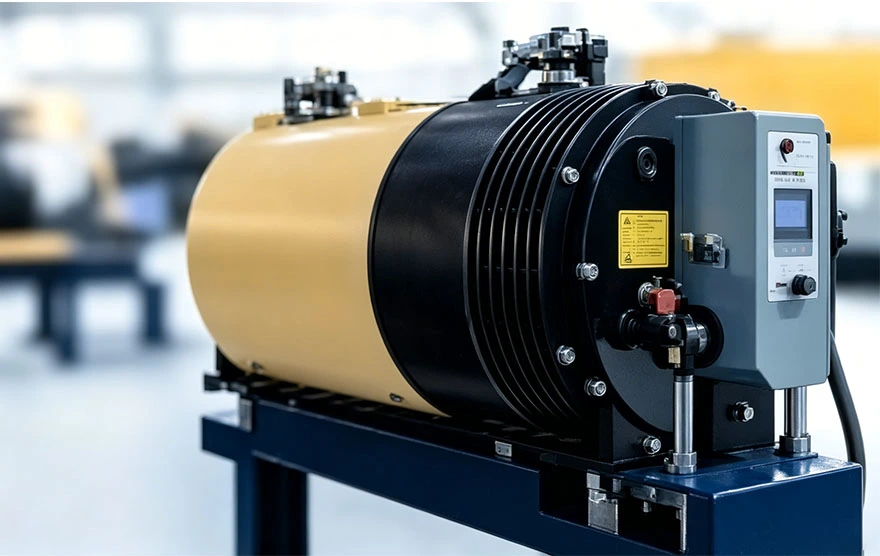
Rotary screw compressors take a radically different approach. Instead of reciprocating motion, they use two intermeshing helical rotors that trap air and progressively reduce its volume—raising pressure in a smooth, continuous sweep.
The result?
Pulse-free airflow – no pressure spikes, no system shock.
No thermal buildup – oil-injected models circulate coolant internally, enabling stable thermal management.
True 100% duty cycle – run it around the clock, 365 days a year, without derating.
From an engineering standpoint, this isn’t just an incremental improvement. It’s a paradigm shift in how industrial air is delivered.
The Numbers That Matter (to Engineers and Plant Managers)
Let’s move beyond theory and look at the metrics that actually impact your bottom line.
| Metric | Reciprocating | Rotary Screw |
|---|---|---|
| Duty Cycle | 50% – 60% | 100% |
| Airflow (CFM per HP) | Baseline | 30%+ higher |
| Moving Parts | Many (valves, pistons, rings) | Few (two rotors) |
| Maintenance Frequency | Quarterly valve/piston checks | Annual oil/filter change (typical) |
| Footprint Efficiency | Larger for same output | Compact, skid-mounted |
For a plant running three shifts, that 30% CFM advantage translates directly into fewer compressors, less floor space, and lower capital expenditure.
Oil-Injected vs. Oil-Free: It’s Not a Competition—It’s a Choice
One of the most frequent questions we hear: “Which one do I need?”
The answer depends entirely on your application.
Oil-Injected Rotary Screw
Best for: General manufacturing, automotive assembly, metal fabrication, construction.
Why: Maximum efficiency, lowest lifetime cost, and bulletproof reliability for harsh environments. The injected oil seals clearances, cools the compression chamber, and lubricates the rotors—all in one closed-loop system.
Oil-Free Rotary Screw
Best for: Pharmaceuticals, food & beverage, electronics, medical air, and paint/powder coating.
Why: Zero risk of oil carryover. These use advanced coatings (like PTFE) and precision timing gears to maintain clearances without liquid lubrication in the compression chamber. Air purity is certified to Class 0 standards.
Engineering Insight: Don’t over-specify oil-free if you don’t need it—you’ll pay a premium in energy and maintenance. But don’t under-specify it if product contamination is a real risk. Match the technology to the criticality of your end product.
Beyond the Rotors: It’s a Complete Thermodynamic System
A well-designed rotary screw compressor isn’t just a pump—it’s an integrated system of interdependent subsystems:
Intake & Filtration – removes particulates before they reach the rotors.
Oil-Injection Loop – cools, seals, and lubricates in real time.
Oil Separation – multi-stage coalescing filters ensure < 2 ppm oil carryover in standard units.
Aftercoolers & Moisture Traps – reduce discharge temperature and remove condensate.
Smart Controllers – modulate capacity from 0% to 100% via variable speed drives (VSD), matching output to actual demand.
When these subsystems work in harmony, the compressor doesn’t just make air—it manages energy, extending component life and slashing electricity bills (which typically account for 70–80% of total lifecycle cost).
The Real ROI: Why Engineers Choose Rotary Screw
We’ve worked with plant engineers who inherited piston-based systems. Their top complaints? Overheating, oil carryover, and unscheduled downtime.
After switching to rotary screw:
Mean Time Between Failures (MTBF) increased by 4x.
Annual maintenance labor dropped by 60%.
Energy consumption per CFM fell by 25% thanks to VSD optimization.
One automotive Tier-1 supplier put it bluntly: “We didn’t buy a compressor. We bought production insurance.”
Final Takeaway: Reliability is Engineered, Not Hoped For
In the world of mechanical engineering, we don’t believe in luck. We believe in margins, tolerances, and duty cycles.
Rotary screw compressors deliver 100% duty cycle because they are designed to. The continuous meshing rotors, the integrated cooling, the reduced friction—all of it points to one conclusion:
If your operation cannot afford to stop, your compressor cannot afford to be reciprocating.
Ready to spec the right system for your plant?
Evaluate your average airflow demand, peak loads, and air-quality requirements. Then match them against oil-injected vs. oil-free, fixed-speed vs. VSD, and total lifecycle cost—not just purchase price.
Because in the end, the cheapest compressor is the one you never have to think about.