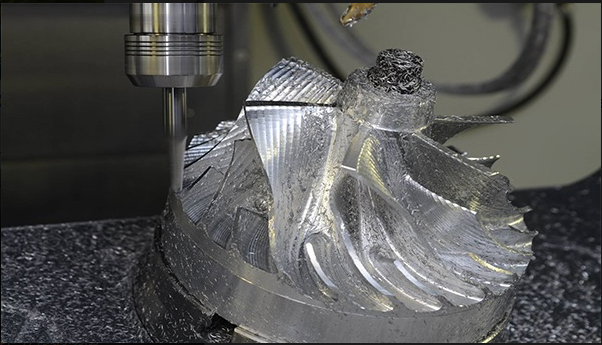

In the world of high-precision manufacturing, impeller machining stands out as the ultimate test for CNC technology. The complex, doubly-curved surfaces of impeller blades are nearly impossible to produce efficiently on standard 3-axis or 4-axis machines.
Understanding why 5-axis CNC machining is essential, and how to leverage its full capabilities, is the key to producing high-performance impellers on time and within budget.
The Geometry Challenge: Why 3-Axis Machining Fails
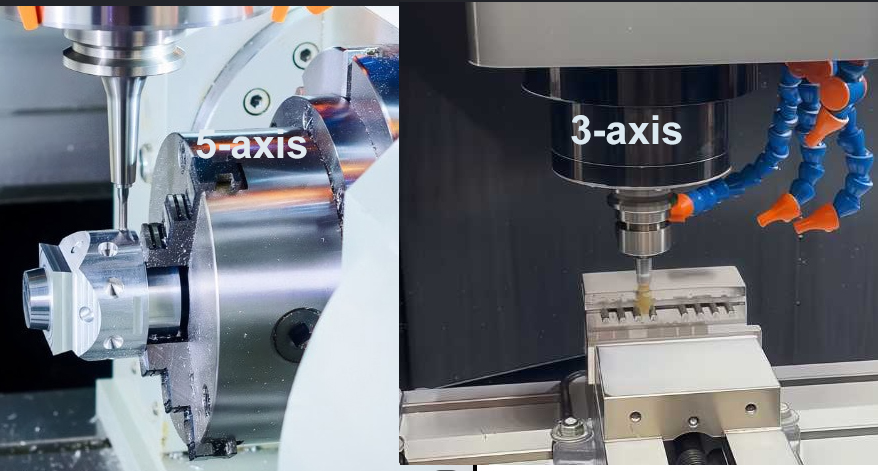
On a traditional 3-axis machine, the cutting tool only approaches the workpiece from the Z-axis (above). While this works for simple parts, impellers present a “line-of-sight” nightmare. Many blade surfaces are physically unreachable from a single orientation.
Limitations of 3-Axis for Impellers:
- Excessive Cycle Times: Machinists are forced to use ball end mills with tiny step-overs, leading to slow production and poor surface finishes.
- Accumulated Errors: Constant re-fixturing to reach different angles introduces positioning errors that compromise the part’s integrity.
- Unreachable Zones: Certain undercut regions near the hub are simply impossible to machine with only three axes.
The result is often an inferior product that requires extensive, costly hand-polishing and fails to meet strict aerodynamic tolerances.
How 5-Axis Machining Transforms Impeller Production
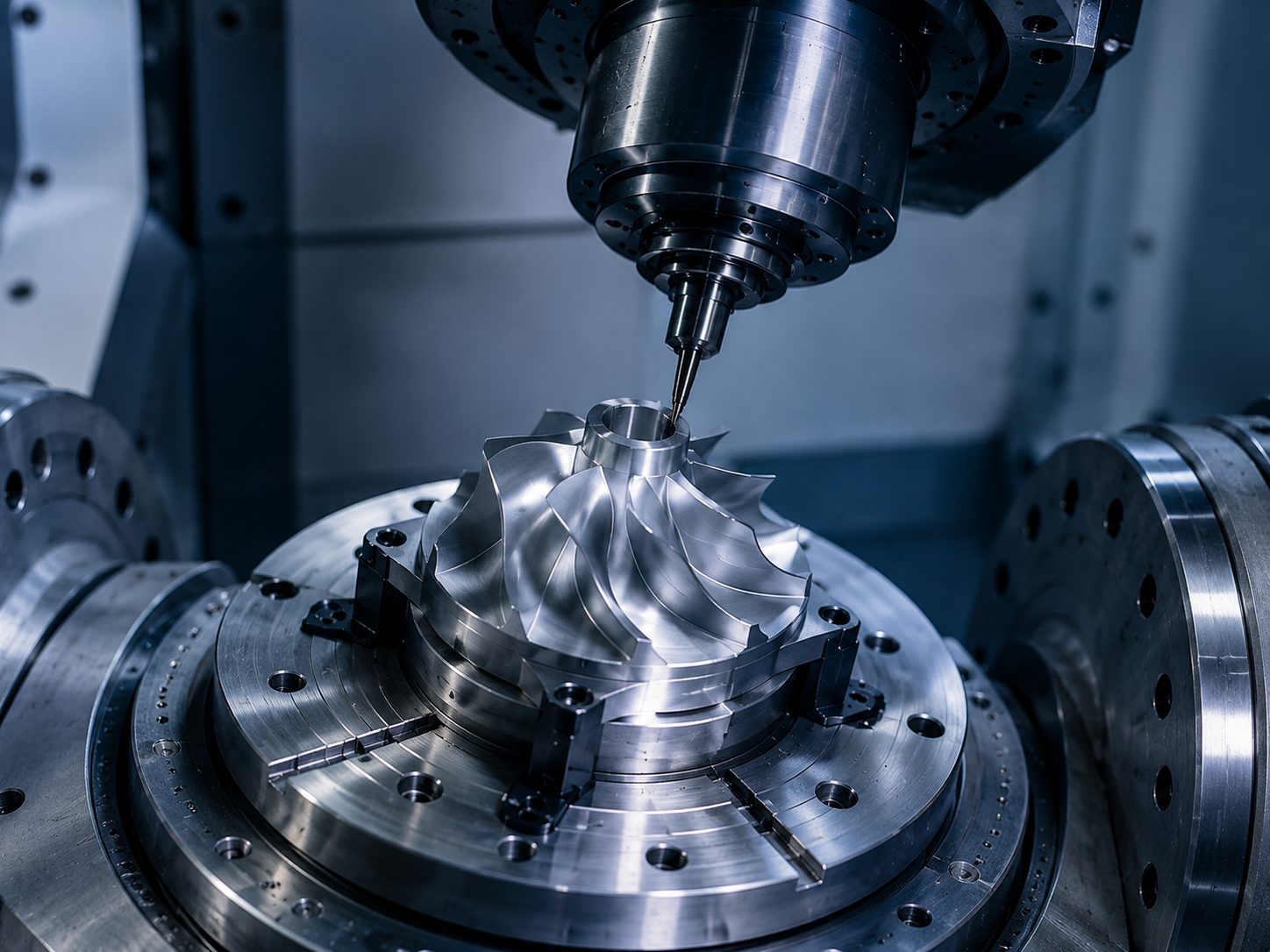
By utilizing professional 5-axis machining services, manufacturers add two rotary axes to the standard X, Y, and Z linear movements. This allows the tool to maintain the optimal cutting angle relative to the blade surface at every single point.
1. Simultaneous 5-Axis Movement
In simultaneous 5-axis machining, all axes move in harmony. The tool tip follows the complex blade profile while the machine continuously tilts the tool to maintain ideal lead and tilt angles. This creates a flawless, continuous surface that eliminates the need for manual finishing.
2. Shorter, More Rigid Tooling
Because the machine can tilt the part or the spindle, you can use significantly shorter cutting tools. Shorter tools are stiffer tools, which results in reduced tool deflection, higher feed rates, and superior surface finishes in deep, tight inter-blade spaces.
3. Precision Through Single-Setup
A 5-axis setup allows for roughing and finishing in a single setup. This ensures that the relationship between the blades and the bore (concentricity) is maintained within microns, eliminating the errors caused by moving the part between multiple fixtures.
Advanced Toolpath Strategies
To maximize the efficiency of CNC machining for impellers, specialized toolpath strategies are employed:
- Swarf Milling (Flank Milling): Uses the side of the tool to remove bulk material between blades much faster than point-milling.
- Morph Toolpaths: Smoothly transitions between guiding curves to ensure uniform stock removal during semi-finishing.
- Flowline Finishing: Follows the natural curvature of the blade, creating a surface texture that aligns with fluid flow for maximum aerodynamic efficiency.
Conclusion: The Hardware and Software Synergy
Success in impeller manufacturing requires more than just a machine; it requires high-speed spindles (20,000+ RPM) and specialized CAM software capable of generating collision-free, optimized toolpaths.
At Tik Precision, we combine state-of-the-art 5-axis CNC technology with industry-leading expertise to deliver impellers for the most demanding Aerospace and Energy Power applications. Contact us today to discuss your next precision project.