
Turbomolecular Pump Blade Machining: High-Speed Precision for Ultra-High Vacuum

Picture of Kenny Gan
Kenny Gan
Share

Table of Contents

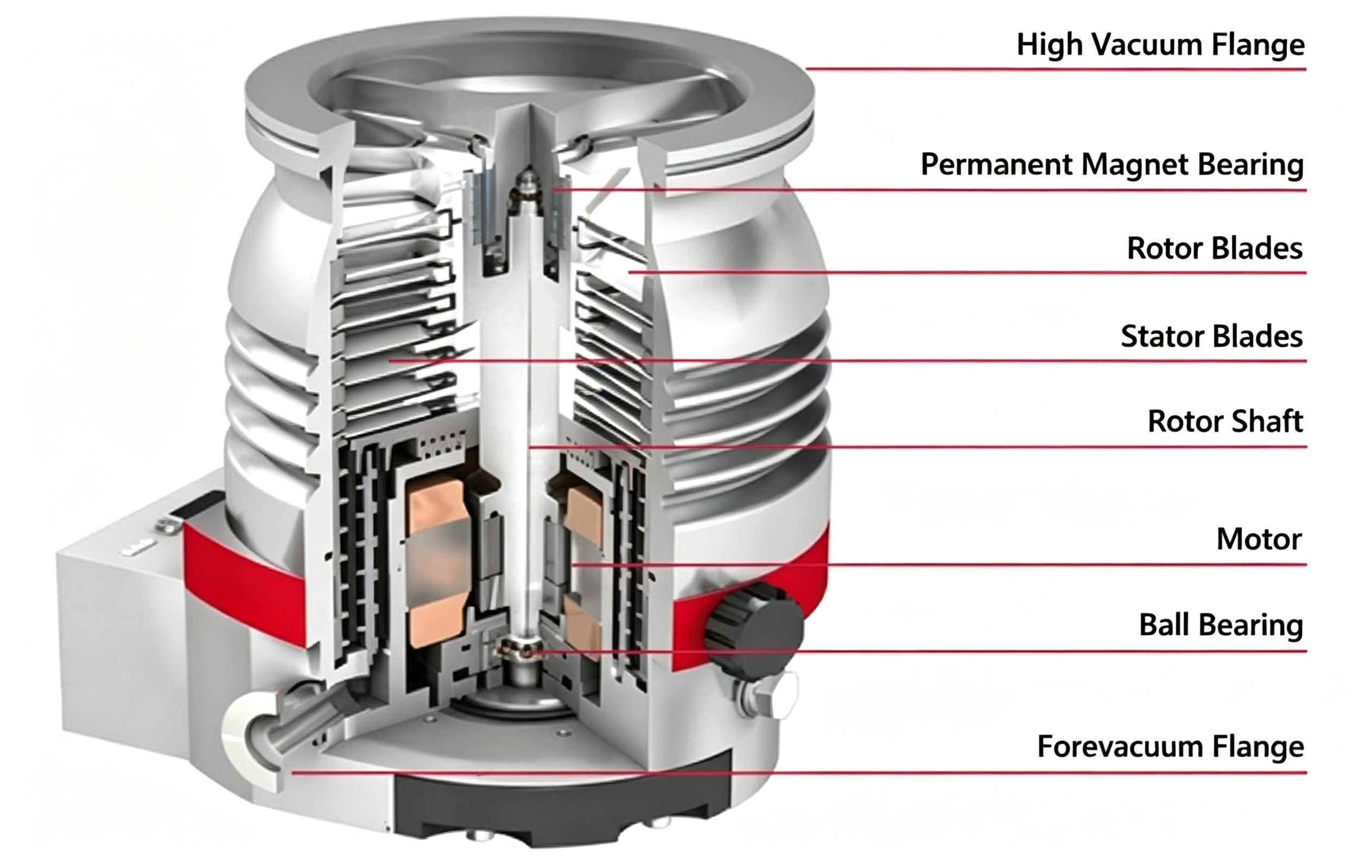
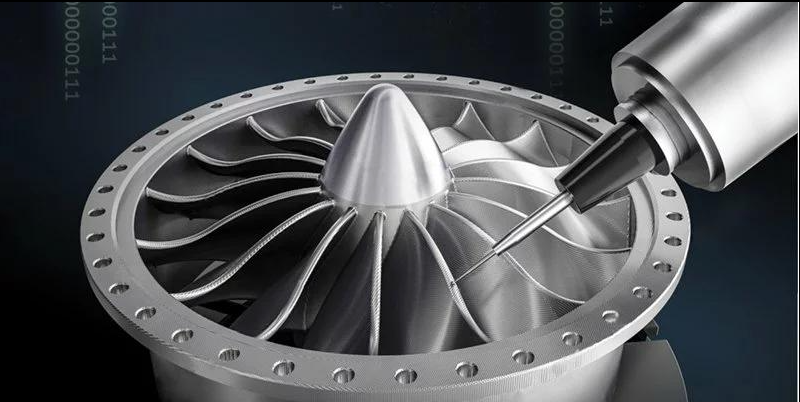
Turbomolecular pumps (TMPs) are the enabling technology for ultra-high vacuum (UHV) — the pressure regime below 10⁻⁸ mbar where semiconductor fabrication, thin-film coating, surface analysis, and particle accelerators operate. A TMP achieves this by stacking multiple stages of rapidly rotating blades interspersed with stationary stators, imparting momentum to individual gas molecules. Rotor speeds of 30,000-90,000 RPM are typical, with blade tip velocities approaching the speed of sound. The CNC machining of these blades demands extreme precision, specialized materials, and a deep understanding of high-speed rotor dynamics.

Free DFM Analysis Before Production

To ensure the success of complex TMP rotor projects, we provide Free Design for Manufacturing (DFM) analysis before production begins. Our engineering team reviews your CAD files to identify potential machining risks, such as tool access limitations in narrow blade channels or thin-wall sections prone to deflection. By optimizing the design early, we help reduce manufacturing costs and prevent lead-time delays.

Blade Geometry: Where Fluid Dynamics Meets Manufacturing

Turbomolecular pump blades operate in the molecular flow regime, where the mean free path of gas molecules exceeds the characteristic dimensions of the pump. Each blade row is an array of thin, precisely angled airfoils arranged radially around a central hub. The geometry is unforgiving: blade angle errors of even 0.5° can measurably reduce pumping speed for a given gas species.

Key Geometric Parameters

  • Blade angle (α): The angle between the blade chord and the plane of rotation. Varies from ~10° at the inlet stages to ~40° at the exhaust stages.
  • Blade chord length and solidity: Determines the probability that a molecule strikes a blade.
  • Blade thickness: Typically 0.5-2.0 mm at the root, tapering to 0.2-0.5 mm at the tip.
  • Hub diameter ratio: Maximizes blade area and pumping speed.

Material Selection

MaterialDensity (g/cm³)Tensile Strength (MPa)Application
Aluminum alloy 7075-T62.81510-570Most common TMP rotor material. High strength-to-weight ratio.
Titanium alloy Ti-6Al-4V4.43900-950Used for higher strength or corrosion resistance.

CNC Machining Approaches

Integral Bladed Rotor (IBR) Machining

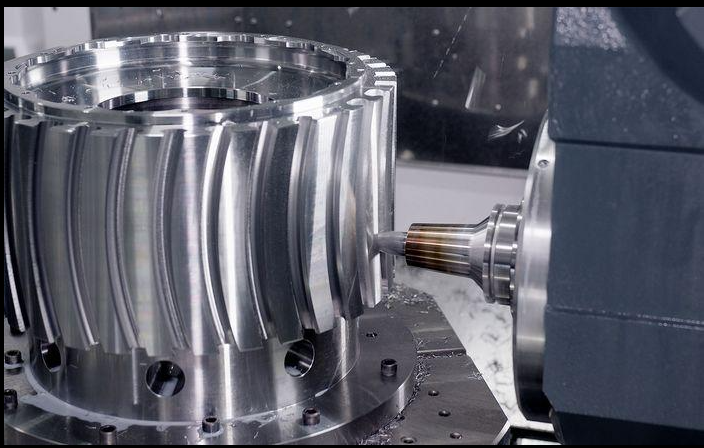
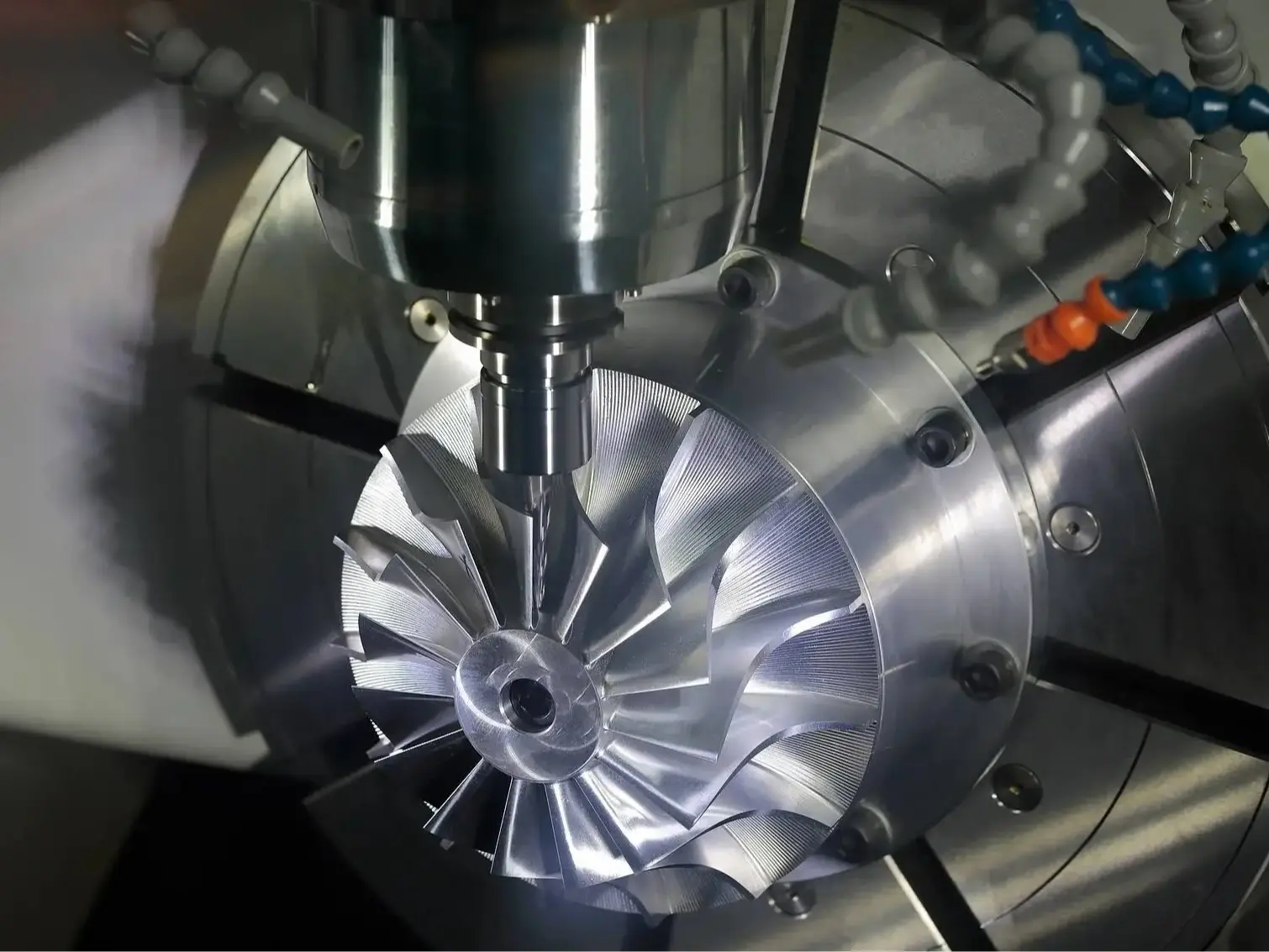
The modern approach to TMP rotor manufacturing is to machine the entire rotor from a single aluminum or titanium forging, eliminating joints and improving dynamic balance.
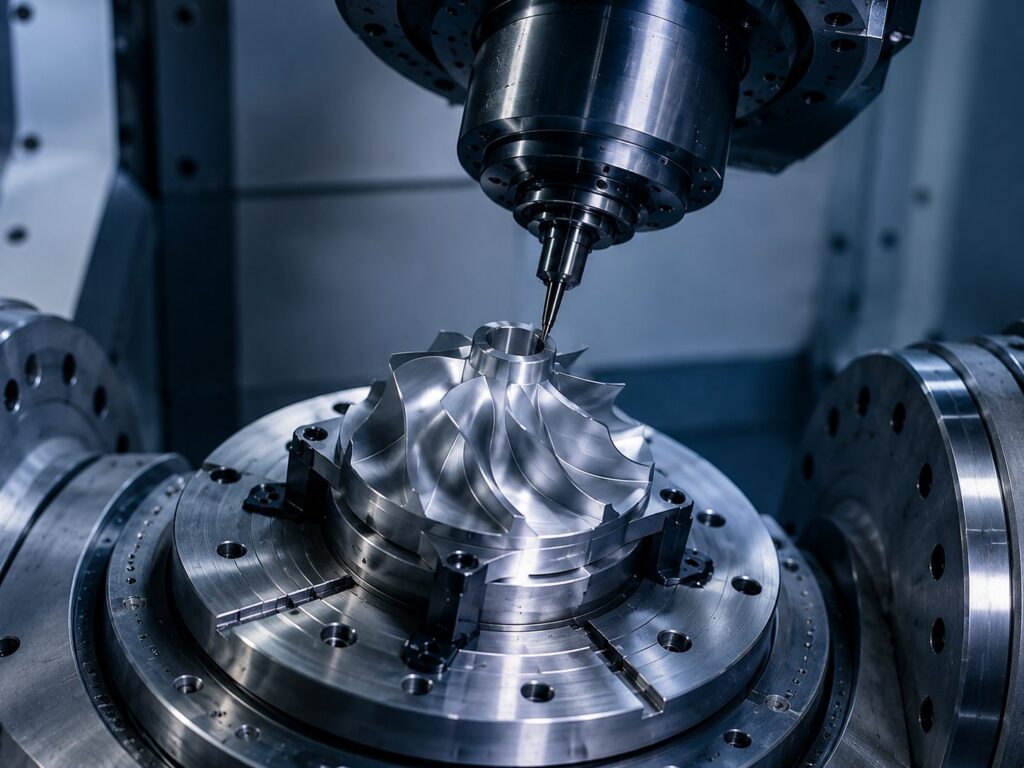
5-axis machining services
5-axis CNC machining process for complex impellers and precision parts.

Quality Verification & CMM Inspection

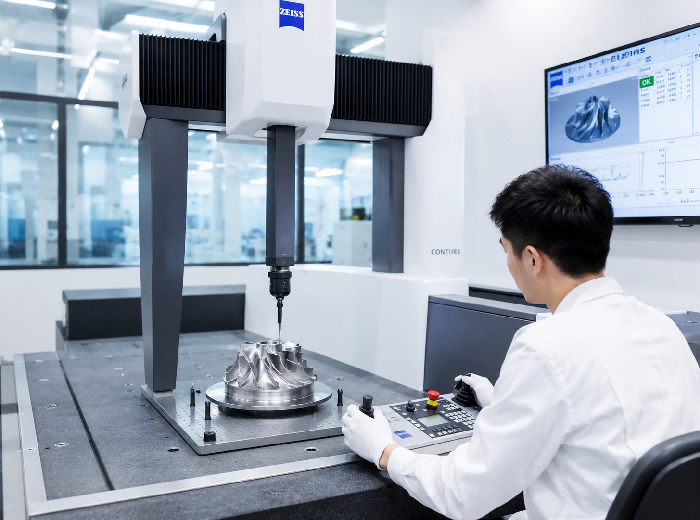
Precision is verified through rigorous Post-Machining CMM Inspection. We utilize high-precision Coordinate Measuring Machines equipped with small-diameter probes (0.3-0.5 mm) to verify blade profiles, angles, and thickness at multiple radial stations. This ensures that every rotor meets the strict dimensional tolerances required for high-speed stability and vacuum performance.
CNC machining services for precision metal and plastic parts
  • Blade geometry measurement: Reported profile deviation and angle accuracy.
  • Surface finish inspection: Typical Ra 0.2-0.4 µm for optimal gas molecule scattering.
  • Dynamic balancing: Balanced to ISO 1940 G0.4 or better.
  • Burst testing: Spin-tested to 110-115% of maximum operating speed.

Tik Precision machines turbomolecular pump rotor blanks and stators on our 5-axis CNC platforms. Contact us to discuss your TMP component requirements and receive your free DFM review.


Need a Manufacturing Quote?

Upload your drawings and receive DFM feedback, material recommendations, and a clear manufacturing quote.

16+

Year

50K+

Parts Manufactured

98.2%

On-time Delivery

Request a Quote
All Articles From The Author
Precision CNC Machining for Optics and Photonics

Precision CNC Machining for Optics and Photonics

Optics manufacturing occupies a unique niche in precision machining — one where surface quality is defined in nanometers, dimensional accuracy in microns, and material

Compressor assembly

Precision CNC Machining for Compressor Components

Compressors are the heart of countless industrial systems — from the turbocharger in a sports car to the multistage centrifugal compressor moving natural gas

Precision CNC Machining for Automotive and Electric Vehicle Manufacturing

The automotive industry is undergoing its most profound transformation in a century. Internal combustion engines are giving way to electric powertrains. Mechanical systems are

Robotics CNC machining services for custom robot parts

Precision CNC Machining for Robotics: Engineering the Future of Automation

Introduction: Why Precision CNC Machining is Vital for Robotics Robotics represents the pinnacle of mechanical engineering, where software intelligence integrates with physical precision. From

Precision Aerospace CNC Machining for High-Temperature Alloys - Tik Precision

Precision CNC Machining for Aerospace: Meeting the Industry”s Toughest Standards

Aerospace manufacturing operates in a world where failure is not an option. Every component — from turbine blades spinning at 15,000 RPM to structural

Vacuum Pump Rotor Balancing and Clearance Control: The Keys to Reliable Performance

The performance and reliability of any vacuum pump — whether Roots blower, screw, claw, scroll, or turbomolecular — hinges on two interrelated factors: rotor

Hub and Spindle Machining for Ducted Fans: The Rotating Core of Precision

The hub (or centerbody) of a ducted fan is the structural heart of the rotating assembly. It supports the blades against centrifugal and aerodynamic

Ducted Fan Assembly Tolerances and Quality Verification: Getting It All Together

The individual components of a ducted fan — rotor, duct, hub, spindle, stators, and bearings — can each be manufactured to exacting standards and

Multi axis CNC machining for high precision custom parts

What is Impeller CNC Machining? A Complete Introduction

Impellers are among the most challenging components to manufacture in modern engineering. These rotating devices — found in pumps, compressors, turbines, and turbochargers —

Start a New Project

Turn Your CAD Files Into Precision Parts

Share your requirements with our engineering team. We will review manufacturability, materials, tolerances and lead time before quoting.

2-Hour Quote

Fast response for complete RFQs

Free DFM Review

Engineering feedback before production

Secure CAD Files

Confidential upload and NDA support

No MOQ

Prototype to low-volume production

Need help preparing an RFQ?

info@tikprecision.com

RFQ Form

Tell Us About Your Project

Upload CAD Files | Free DFM Analysis | 2-Hour Quote | No MOQ Required | NDA Protected