From prototype validation to low-volume pilot runs, engineers and procurement teams often need to choose between CNC machining, 3D printing (additive manufacturing), and injection molding. These three aren’t interchangeable — each suits a different stage of development and volume range. This article offers a selection framework based on volume, precision, and material performance to help you optimize your Quality Control and production strategy.
1. Core Characteristics Compared
| Dimension | CNC Machining | 3D Printing (FDM/SLA/SLS) | Injection Molding |
|---|---|---|---|
| Ideal volume range | 1–1,000 units | 1–50 units (mainly prototyping) | Economical above ~500 units |
| Upfront cost | Moderate (no tooling required) | Low | High (tooling typically tens of thousands of dollars) |
| Unit cost vs. volume | Gradual decline | Roughly flat | Sharp decline with volume |
| Mechanical properties | Matches raw material, most reliable | Weaker interlayer strength, notable anisotropy | Close to standard injection-grade material specs |
| Dimensional accuracy | ±0.02–0.05mm | ±0.1–0.3mm (process-dependent) | ±0.05–0.1mm (mold-design dependent) |
| Complex internal geometry | Limited by tool accessibility | Nearly unlimited (especially SLS/SLA) | Limited by mold draw direction |
| Prototype lead time | 3–7 days | 1–3 days | Mold build typically 2–6 weeks |
2. Where CNC Machining Wins
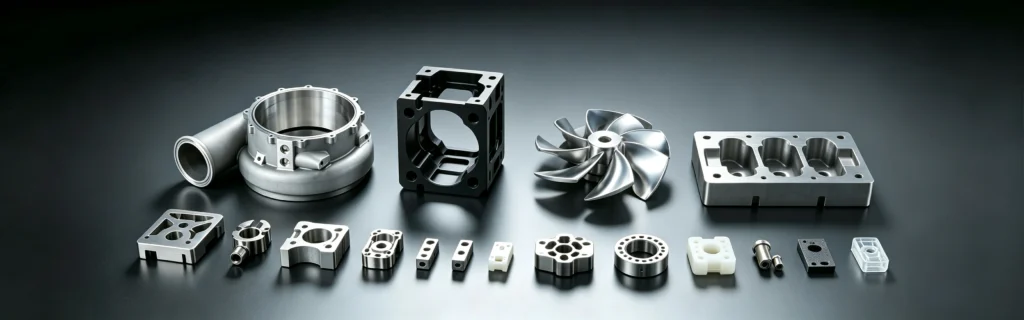
- Functional prototype validation: Scenarios requiring real material mechanical properties for assembly and strength testing
- Low-volume metal structural parts: Batches in the tens-to-hundreds range, not yet large enough to justify tooling cost
- High-precision fit components: Shaft-hole fits, threaded connections, and other features requiring tight tolerance control
- Low-volume alternative for engineering plastics: When volume can’t amortize tooling cost, CNC machining engineering plastics (POM, PA66, etc.) serves as a bridge solution
3. Where 3D Printing Fits
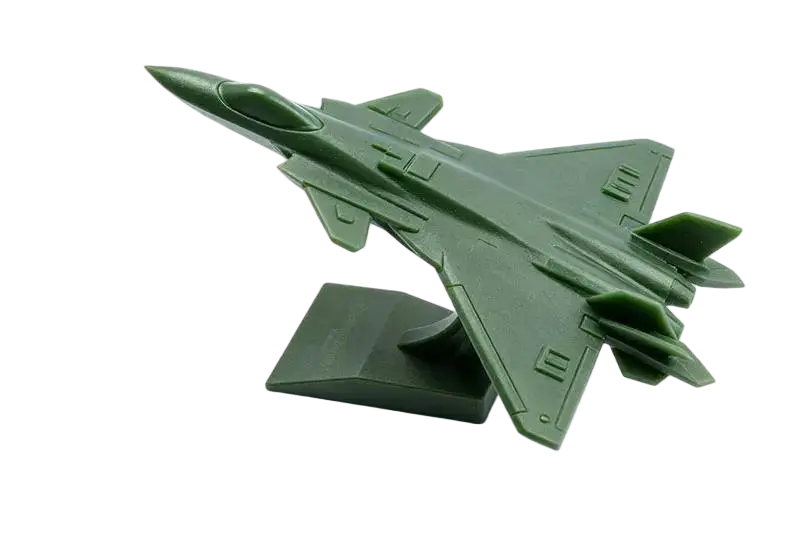
3D printing offers irreplaceable advantages in these scenarios:
- Complex internal channels, topology-optimized structures that CNC simply cannot machine
- Extremely fast cosmetic prototype validation (same-day turnaround)
- Customized, single-unit or small-batch personalized products (e.g., custom medical devices)
Note: 3D printed parts typically have lower mechanical properties than the equivalent CNC-machined or injection-molded part, particularly in interlayer tensile strength. It’s not recommended for functional validation under significant loads unless thoroughly material-tested first.
4. The Economic Break-Even Point for Injection Molding
Mold tooling represents injection molding’s biggest upfront investment:
- Simple single-cavity molds: typically low thousands to tens of thousands of dollars
- Complex multi-cavity precision molds: can reach into six figures
Rule of thumb: When projected annual demand exceeds roughly 1,000-3,000 units (depending on part complexity), injection molding’s unit cost advantage starts to clearly outweigh CNC machining. Below that range, CNC machining’s total cost of ownership — especially considering it avoids the capital lock-up and risk of tooling — is often more competitive.
5. A Hybrid Strategy: Not Always an Either/Or Decision
Mature product development processes often combine all three across stages:
- Concept validation stage: 3D printing for rapid iteration, validating appearance and fit
- Functional validation and pilot production stage: CNC machining produces real-material samples for strength and environmental testing
- Volume production stage: Once volume reaches economic scale, transition to injection molding — and CNC machining itself often produces the mold inserts and cavities (CNC and injection molding are also upstream/downstream partners in the value chain)
6. Advice for Procurement Teams
Sync with R&D on volume forecasts and expected design iteration frequency during project review. If a design is still undergoing frequent changes, committing to injection tooling too early carries significant risk cost (scrapped or revised molds) that can far exceed the per-unit premium of CNC machining. Process selection ultimately balances development timeline, iteration cost, and volume economics for the project’s current stage — not simply “which process is cheapest.”