Facing wildly different quotes for the same drawing, procurement engineers often struggle to judge whether a price is reasonable. This article breaks down the cost structure behind a CNC machining quote to help procurement teams build stronger negotiation and comparison skills.
1. Five Core Cost Drivers in CNC Machining
1. Material Cost
Includes raw material purchase price plus machining waste. Bar stock utilization typically runs 40-70%, with more complex parts producing higher scrap ratios. Specialty materials (titanium, PEEK, etc.) can account for over 40% of total cost.
2. Machining Labor / Machine Time
The largest and most frequently underestimated portion of a quote, driven by:
- Net cutting time per part (directly tied to part complexity and material removal volume)
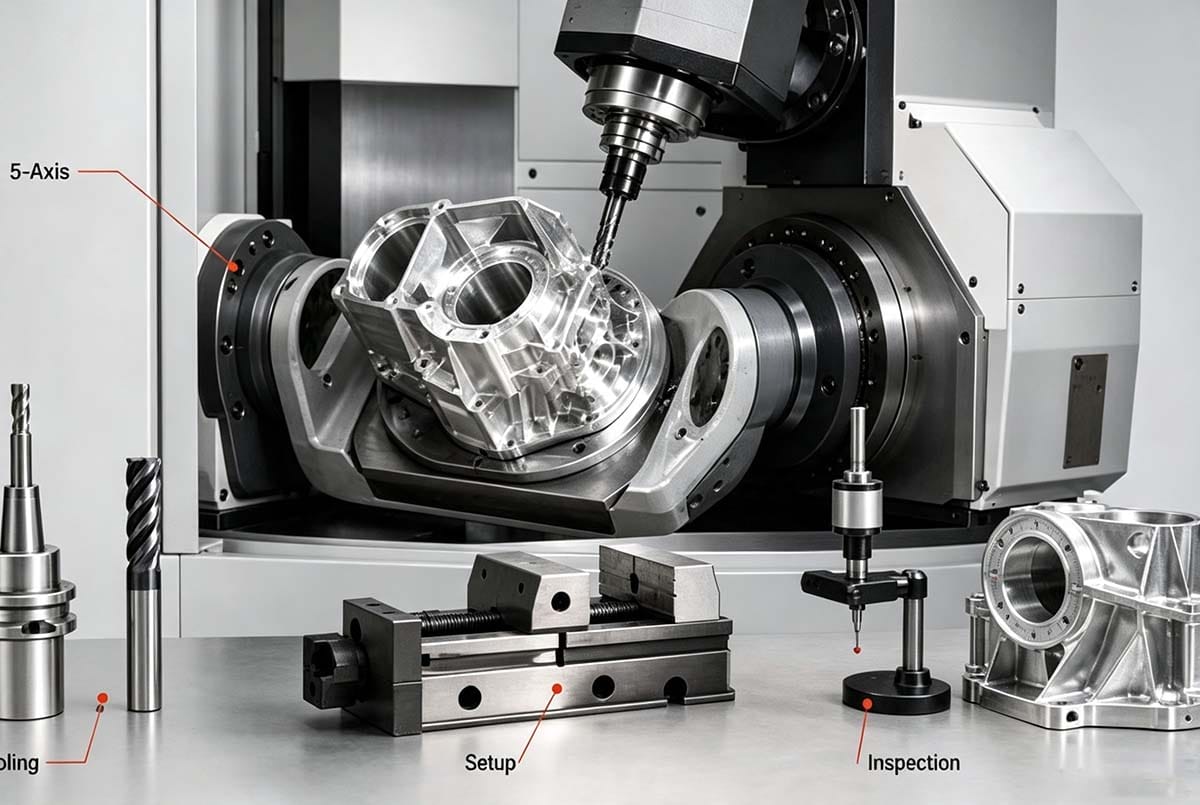
- Fixturing and tool-change time (more setups mean more auxiliary time)
- Machine hourly rate (3-axis, 4-axis, and 5-axis rates can differ by 2-4x)
3. Programming and Tooling/Fixture Cost
CAM programming for complex parts can account for 10-20% of a quote, especially at the prototype stage. Custom fixture costs are typically amortized as a one-time charge on the first batch, with the per-unit impact shrinking as order volume grows.
4. Tool Wear Cost
Carbide or PCD tooling wears faster when machining difficult materials like titanium or stainless steel, meaningfully raising per-unit price — one major reason quotes vary so much between materials.
5. Surface Finishing and Inspection Cost
Outsourced surface finishing is typically billed by area or batch, while inspection cost depends on the number of critical dimensions and inspection method (calipers/micrometers vs. CMM).
2. Why Quotes for the Same Drawing Can Vary 2-3x
Common causes include:
- Equipment mismatch: Using 5-axis equipment for a part that only needs 3-axis inflates the machine rate unnecessarily
- Different tolerance interpretation: Some suppliers quote the whole part at the tightest called-out tolerance for unspecified dimensions; others default to general tolerance standards
- Different volume amortization logic: For small batches, how programming and fixture cost gets amortized significantly affects unit price
- Capacity and scheduling pressure: Off-season quotes tend to be more competitive; suppliers may raise prices during peak season to filter incoming orders
3. Where to Negotiate Effectively
Rather than simply pushing for a lower price, focus on optimizing the cost structure:
- Consolidate order batches: Combine machining plans for multiple parts into a single order to spread programming and fixture cost
- Loosen non-critical tolerances: Clearly distinguish critical dimensions from reference dimensions to avoid a supplier quoting the entire part at the tightest tolerance (see the tolerance-callout article)
- Evaluate material alternatives: Where performance allows, assess more machinable material grades
- Optimize inspection scope: Not every dimension needs full CMM inspection — a combination of sampling plus full check on critical dimensions is often more cost-effective
4. Quote Review Checklist
Request itemized breakdowns rather than a single total price, and check for:
- [ ] Material cost and machining cost listed separately
- [ ] Equipment type specified (3/4/5-axis)
- [ ] Surface finishing cost includes logistics to the outsourced vendor
- [ ] Inspection cost tied to a specific method and report type
- [ ] First-article/prototype cost separated from volume unit pricing
5. Beware of the “Low Price Trap”
An unusually low quote often signals one of the following risks: the supplier is cutting corners on inspection, substituting off-spec material, or won’t be able to hit the promised lead time. For quotes that differ by more than 30% from the field, seek detailed clarification rather than defaulting to the lowest bidder. In long-term partnerships, the reliability of quality consistency and delivery — the hidden costs they save you — typically far outweighs the difference in unit price.
Understanding cost structure not only strengthens procurement negotiation but also helps engineers avoid non-essential design choices that unnecessarily drive up machining cost.