
The Complete Guide to Anodizing Aluminum CNC Parts

Picture of Kenny Gan
Kenny Gan
Share

Table of Contents

Introduction: Enhancing Aluminum Components Through Anodizing

Anodizing is the premier surface treatment for aluminum CNC parts, providing a unique combination of aesthetic appeal, surface hardness, and corrosion resistance. Unlike traditional coatings, anodizing is an electrochemical process that converts the aluminum surface into a durable aluminum oxide layer. This layer is integral to the substrate, ensuring it will not chip or peel under industrial stress.

At Tik Precision, we integrate high-quality finishing into our CNC machining services. Understanding the technical nuances of Type II and Type III anodizing is essential for engineering parts that meet both functional and dimensional requirements.


The Science of Anodizing: How the Oxide Layer Grows

During the anodizing process, aluminum parts act as the anode in an acid electrolyte bath. The resulting electrochemical reaction forms aluminum oxide (Al₂O₃), a ceramic-like structure with hardness approaching sapphire. A critical factor for tight CNC tolerances is understanding that the oxide layer grows both inward and outward—typically one-third into the metal and two-thirds building above the surface.


Comparing Anodizing Types: Decorative vs. Hardcoat

Type II Anodizing (Decorative & Protective)

Type II is the standard for most CNC milling projects. It offers moderate wear resistance and is highly versatile for aesthetic finishes.

  • Thickness: 5-25 µm.
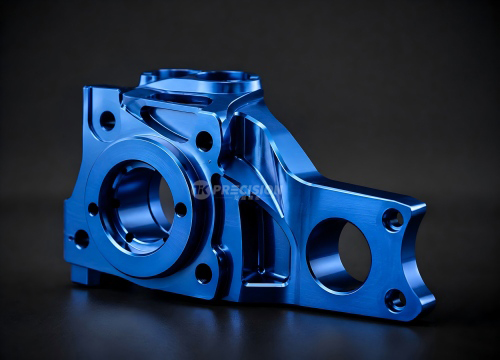
  • Aesthetics: Can be dyed in vibrant colors (Black, Blue, Red, Gold).
  • Applications: Consumer electronics, enclosures, and automotive trim.

Type III Hardcoat Anodizing (Industrial Wear)

Designed for extreme environments, Type III provides a surface harder than case-hardened steel.

  • Thickness: 25-100 µm.
  • Performance: Superior abrasion resistance and dielectric properties.
  • Applications: Aerospace landing gear, hydraulic cylinders, and sliding wear surfaces.

Dimensional Considerations for Precision Parts

Anodizing changes the physical dimensions of a part. For precision CNC turned parts, engineers must account for this growth during the machining phase:

  • External Diameters: Increase by approximately two-thirds of the total coating thickness.
  • Internal Bores: Decrease as the coating grows inward.
  • Threaded Features: Require “loose” machining tolerances to ensure fitment after the dielectric layer is applied.

Conclusion: Engineering Excellence with Tik Precision

Choosing the right anodizing specification is vital for the longevity and performance of your aluminum components. Tik Precision offers comprehensive support, from DFM (Design for Manufacturability) to final surface finishing, ensuring your parts meet the highest industrial standards.

Contact our technical team today to discuss your aluminum anodizing and CNC machining requirements!


Need a Manufacturing Quote?

Upload your drawings and receive DFM feedback, material recommendations, and a clear manufacturing quote.

16+

Year

50K+

Parts Manufactured

98.2%

On-time Delivery

Request a Quote
All Articles From The Author
Compressor assembly

Precision CNC Machining for Compressor Components

Compressors are the heart of countless industrial systems — from the turbocharger in a sports car to the multistage centrifugal compressor moving natural gas

Precision CNC Machining for Automotive and Electric Vehicle Manufacturing

The automotive industry is undergoing its most profound transformation in a century. Internal combustion engines are giving way to electric powertrains. Mechanical systems are

Robotics CNC machining services for custom robot parts

Precision CNC Machining for Robotics: Engineering the Future of Automation

Introduction: Why Precision CNC Machining is Vital for Robotics Robotics represents the pinnacle of mechanical engineering, where software intelligence integrates with physical precision. From

Precision Aerospace CNC Machining for High-Temperature Alloys - Tik Precision

Precision CNC Machining for Aerospace: Meeting the Industry”s Toughest Standards

Aerospace manufacturing operates in a world where failure is not an option. Every component — from turbine blades spinning at 15,000 RPM to structural

Turbomolecular Pump Blade Machining: High-Speed Precision for Ultra-High Vacuum

Turbomolecular pumps (TMPs) are the enabling technology for ultra-high vacuum (UHV) — the pressure regime below 10⁻⁸ mbar where semiconductor fabrication, thin-film coating, surface

Vacuum Pump Rotor Balancing and Clearance Control: The Keys to Reliable Performance

The performance and reliability of any vacuum pump — whether Roots blower, screw, claw, scroll, or turbomolecular — hinges on two interrelated factors: rotor

Hub and Spindle Machining for Ducted Fans: The Rotating Core of Precision

The hub (or centerbody) of a ducted fan is the structural heart of the rotating assembly. It supports the blades against centrifugal and aerodynamic

Ducted Fan Assembly Tolerances and Quality Verification: Getting It All Together

The individual components of a ducted fan — rotor, duct, hub, spindle, stators, and bearings — can each be manufactured to exacting standards and

Multi axis CNC machining for high precision custom parts

What is Impeller CNC Machining? A Complete Introduction

Impellers are among the most challenging components to manufacture in modern engineering. These rotating devices — found in pumps, compressors, turbines, and turbochargers —

Start a New Project

Turn Your CAD Files Into Precision Parts

Share your requirements with our engineering team. We will review manufacturability, materials, tolerances and lead time before quoting.

2-Hour Quote

Fast response for complete RFQs

Free DFM Review

Engineering feedback before production

Secure CAD Files

Confidential upload and NDA support

No MOQ

Prototype to low-volume production

Need help preparing an RFQ?

info@tikprecision.com

RFQ Form

Tell Us About Your Project

Upload CAD Files | Free DFM Analysis | 2-Hour Quote | No MOQ Required | NDA Protected