
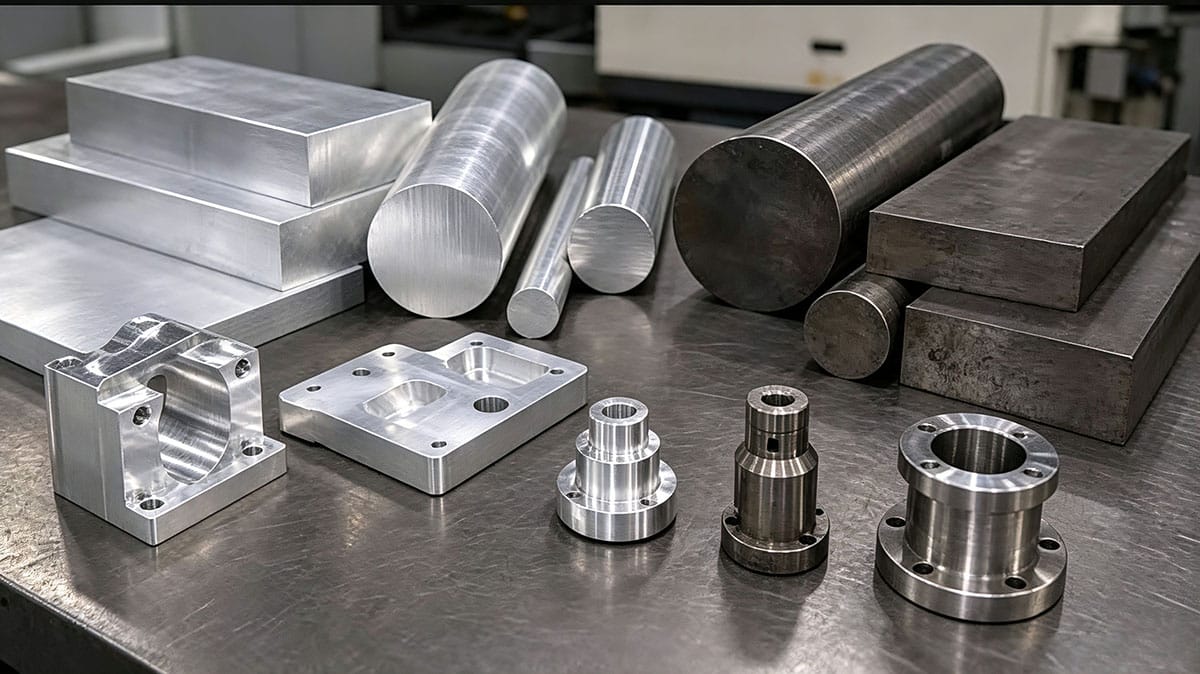
Material selection has more impact on part performance, cost, and lead time than almost any other decision in the design process. Choosing between Aluminum vs Titanium vs Stainless Steel requires balancing mechanical properties with manufacturing feasibility. Here’s a practical comparison of these common CNC machining materials to help you optimize your project.
Aluminum Alloys: The Versatile Choice
Aluminum (6061, 7075, 5052) is the default choice for many precision CNC machining services. It offers a unique combination of lightweight properties and high thermal conductivity.
- Excellent Machinability: Faster cycle times lead to lower overall machining costs.
- Strength-to-Weight: Ideal for weight-sensitive applications like drone and robotics components.
- Surface Finishing: Naturally corrosion-resistant and responds exceptionally well to anodizing for cosmetic or protective finishes.
Watch out for: Lower absolute strength compared to steel or titanium, making it less suitable for extreme high-load structural parts.
Titanium Alloys: High-Performance Strength
Titanium (Grade 5/Ti-6Al-4V) is the gold standard for aerospace CNC machining. It provides unmatched durability in harsh environments.
- Superior Strength: High mechanical strength with significantly lower density than steel.
- Extreme Resistance: Excellent heat and corrosion resistance, perfect for marine and aerospace turbine parts.
- Biocompatibility: A primary choice for medical implants and surgical instruments.
Watch out for: Titanium is difficult to machine. It generates intense heat and causes rapid tool wear, resulting in higher material and labor costs.
Stainless Steel: Durability and Corrosion Resistance
Stainless steel (304, 316L, 17-4PH) is favored for its ruggedness. When machining exotic alloys or standard grades, stainless steel ensures long-term part survival.
- Corrosion Protection: 316L is specifically resistant to pitting in marine or chemical environments.
- Wear Resistance: High hardness makes it ideal for industrial components subject to friction.
- Stability: Maintains excellent dimensional stability under heavy loads.
Watch out for: It is significantly heavier than aluminum. The increased hardness requires specialized tooling and slower feed rates.
Aluminum vs Titanium vs Stainless Steel Comparison
| Property | Aluminum | Titanium | Stainless Steel |
|---|---|---|---|
| Weight | Lightest | Light | Heaviest |
| Strength | Moderate | High | High |
| Corrosion resistance | Good | Excellent | Excellent |
| Machinability | Excellent | Difficult | Moderate |
| Relative cost | Lowest | Highest | Mid-to-high |
Frequently Asked Questions
Which material is best for aerospace? While titanium is used for high-stress areas, aluminum remains vital for non-critical structural parts to maximize weight savings.
Why choose 316L for medical use? Its molybdenum content provides superior resistance to bodily fluids and repeated sterilization cycles.
Conclusion
Choosing between Aluminum vs Titanium vs Stainless Steel depends on your specific application requirements. Whether you need the lightweight efficiency of aluminum, the extreme strength of titanium, or the durability of stainless steel, Tik Precision can help. Contact our engineering team for a detailed material consultation today.