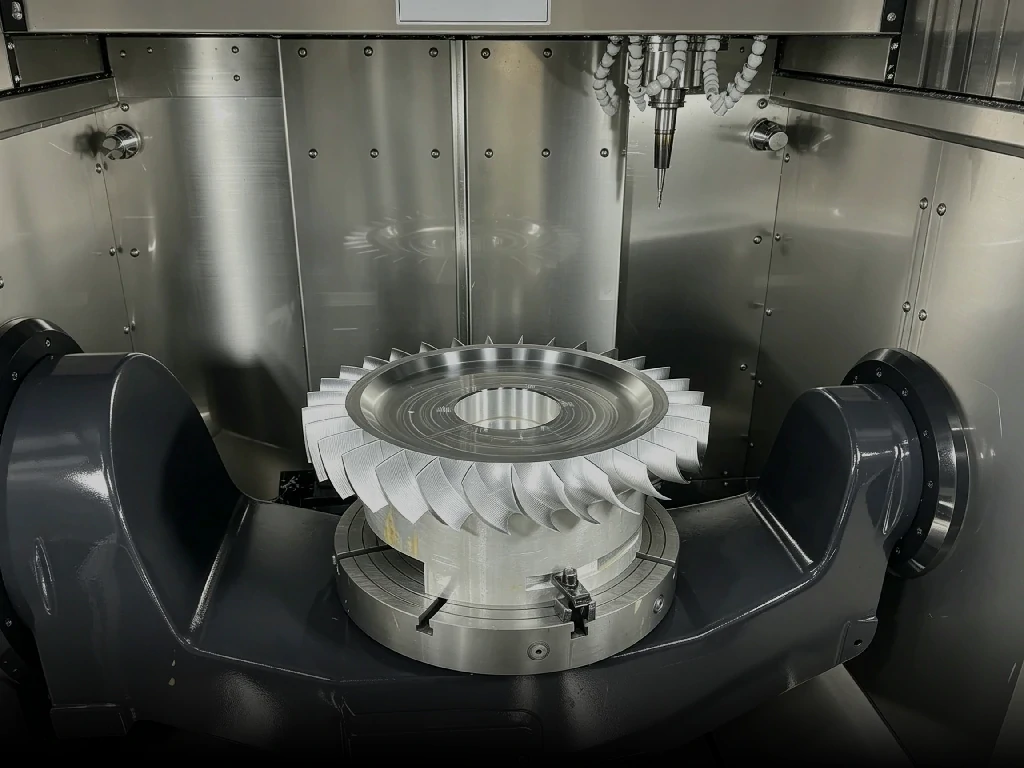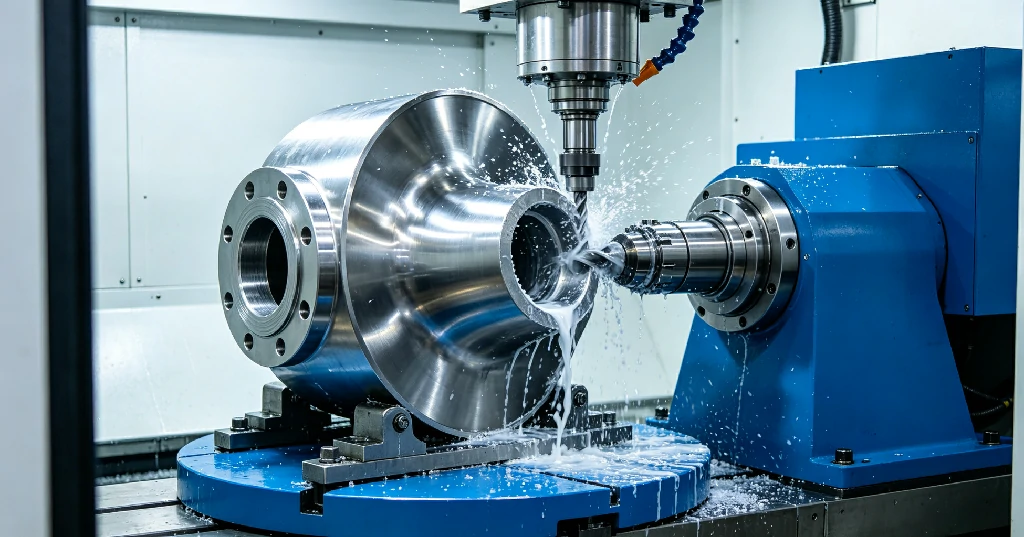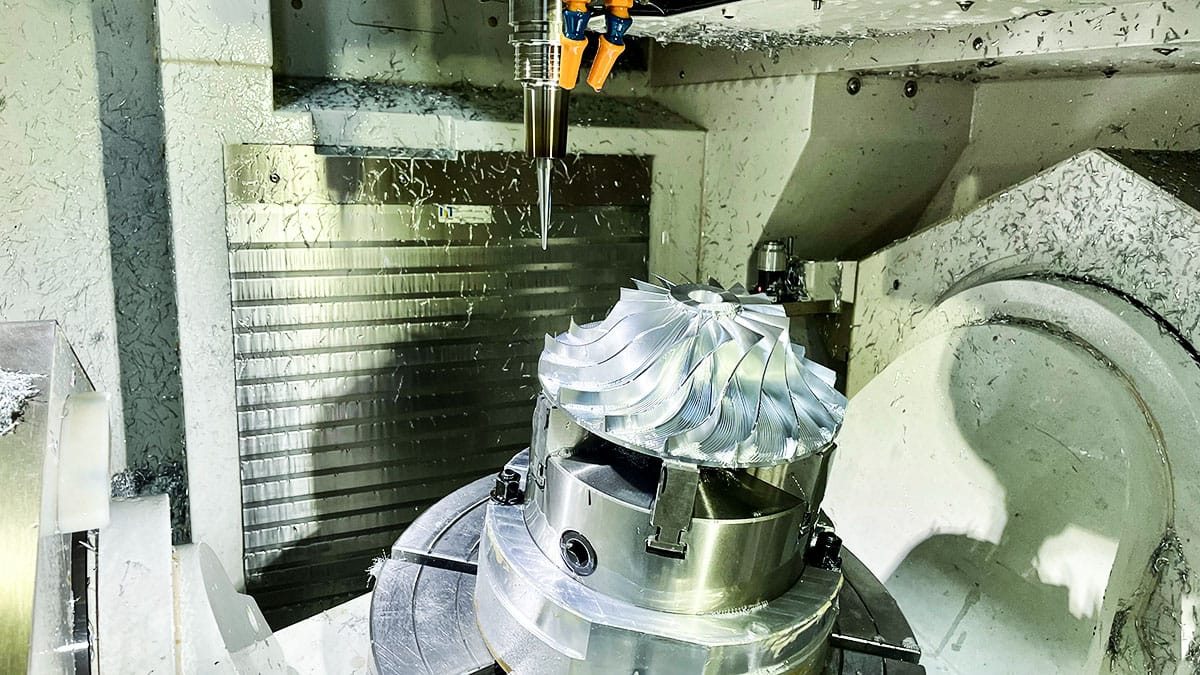

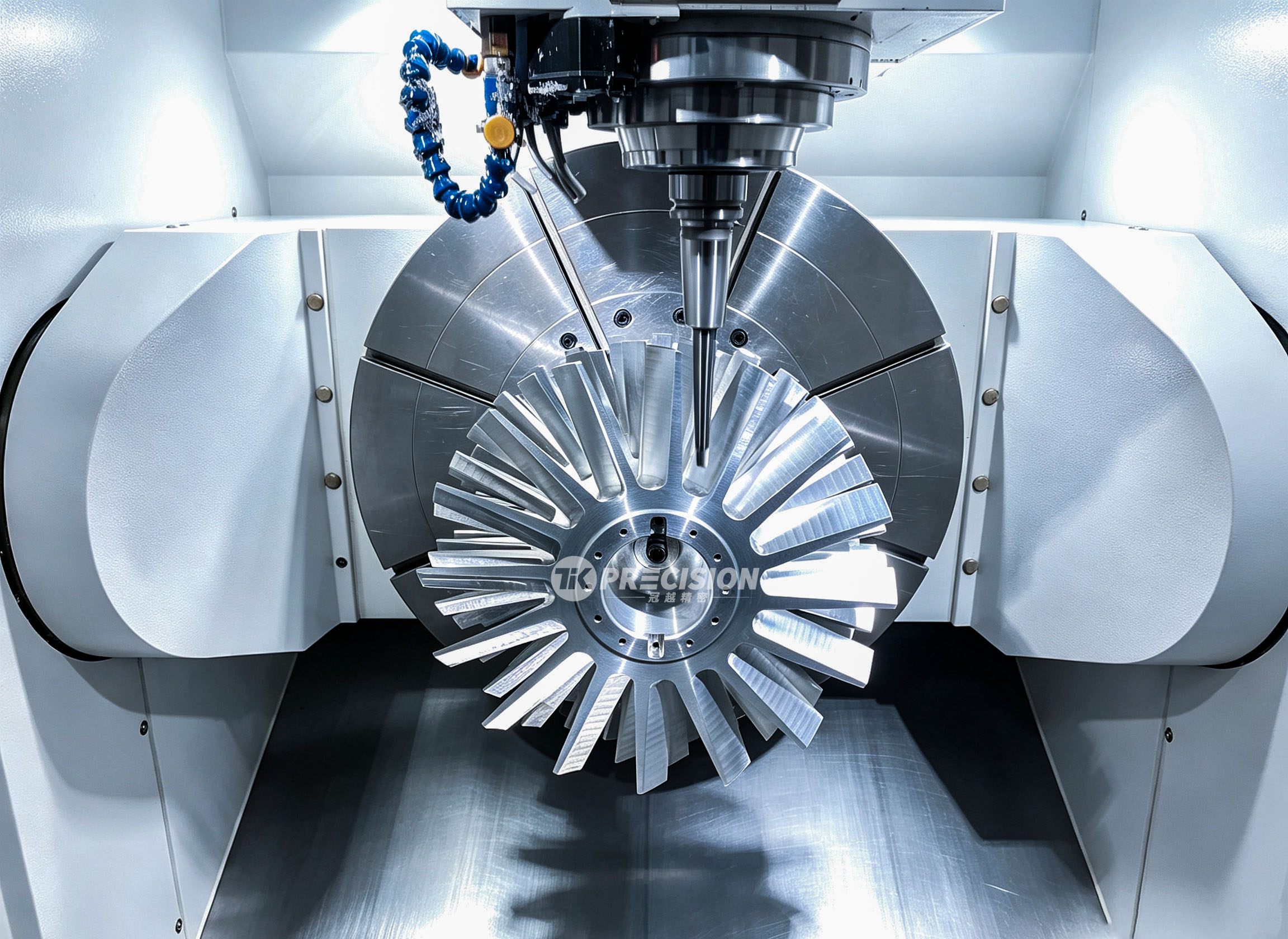
An impeller fresh off the CNC machine is geometrically complete but functionally unfinished. The surface treatments applied after machining — polishing, coating, shot peening, or chemical processing — determine how the impeller interacts with its operating environment. The right finish can extend service life by years; the wrong one can cause premature failure within hours. This guide covers the post-machining surface treatments commonly applied to precision CNC impellers.
Why Impellers Need Surface Treatment
Impellers operate under conditions that attack surfaces in multiple ways simultaneously:
- Fluid erosion: High-velocity fluid — especially when carrying entrained particles — gradually erodes blade surfaces, changing the blade profile and reducing efficiency.
- Cavitation damage: Vapor bubble collapse creates microscopic shockwaves that pit and erode surfaces — particularly near the blade leading edges and tips.
- Corrosion: The pumped fluid may be chemically aggressive (acids, seawater, process chemicals) or create galvanic corrosion conditions.
- Fatigue: Cyclic stress at high RPM initiates cracks at surface imperfections. Compression in the surface layer can dramatically improve fatigue life.
- Fouling: In some applications, material deposits on blade surfaces change the hydraulic profile and reduce performance.
Surface treatments address one or more of these failure mechanisms.
Mechanical Polishing
Process: The impeller is polished using progressively finer abrasives — starting at 120-240 grit and progressing to 600-1200 grit or finer — applied with rotary tools, belts, or hand pads. For complex blade geometries, robotic polishing cells are increasingly used for consistency.
Results: Surface roughness reduced to Ra 0.2-0.4 µm. Mirror finishes are possible with final polishing compounds (diamond paste or alumina slurry).
Best for: Pump impellers where surface roughness directly affects hydraulic efficiency; food-grade impellers where surface smoothness prevents product adhesion and simplifies CIP (clean-in-place); stainless steel impellers for pharmaceutical applications.
Limitations: Labor-intensive and difficult to automate for complex geometries. Polishing removes a small amount of material, so blade thickness must account for this. Polishing compounds can become embedded in the surface if not thoroughly cleaned.
Electropolishing
Process: The impeller is immersed in an electrolytic bath and connected as the anode. Electric current preferentially dissolves surface peaks (microscopic high points), producing a smoother, brighter surface. Unlike mechanical polishing, electropolishing reaches every surface the electrolyte contacts — including internal passages and deep inter-blade cavities that polishing tools cannot reach.
Results: Surface roughness reduced to Ra 0.1 µm or better. The process also passivates stainless steel surfaces — removing free iron and enriching the surface in chromium — enhancing corrosion resistance.
Best for: Stainless steel impellers for pharmaceutical, food, and semiconductor applications where surface finish and corrosion resistance are both critical. Blood pump impellers where hemocompatibility demands the smoothest possible surface.
Limitations: Works only on conductive materials (stainless steel, titanium, cobalt-chrome — not aluminum). Removes material preferentially at sharp edges, so blade edges must be designed with this in mind. Fixturing to ensure uniform current density across complex impeller geometry requires experience.
Shot Peening
Process: The impeller surface is bombarded with small spherical media — steel shot, glass beads, or ceramic beads — at high velocity. Each impact creates a small dimple of plastic deformation, inducing a thin layer of compressive residual stress at the surface.
Results: Fatigue life improved by 50-300% depending on material and peening intensity. The compressive surface layer prevents crack initiation and propagation.
Parameters:
- Almen intensity: Measured in Almen strip deflection (0.15-0.30 mm A-scale for general applications; 0.30-0.50 mm for high-stress impellers).
- Coverage: Specified as percentage of surface impacted (100% minimum; 200% for critical aerospace applications).
- Media type and size: Steel shot S170-S330 for steel impellers; glass beads for non-ferrous alloys to avoid iron contamination.
Best for: Aerospace compressor and turbine impellers; turbocharger compressor wheels; high-speed pump impellers where cyclic fatigue is a primary failure mode; any impeller where a specified fatigue life must be demonstrated.
Limitations: Shot peening roughens the surface — it is not a finishing process. If a smooth surface finish is also required, shot peening is performed before final polishing or electropolishing, not after. Overshot peening can cause surface damage and reduce rather than improve fatigue life.
Anodizing and Hardcoat Anodizing
Process: Electrochemical conversion of the aluminum surface into a controlled-thickness aluminum oxide layer. Type II anodizing produces a 5-25 µm decorative and protective layer; Type III (hardcoat) produces a 25-100 µm layer with hardness approaching 60-70 HRC equivalent.
Results: Enhanced corrosion resistance, increased surface hardness, and the ability to accept dyes for color coding or aesthetic requirements. Hardcoat anodizing provides wear resistance comparable to case-hardened steel.
Best for: Aluminum impellers — turbocharger compressor wheels, industrial fan impellers, light-duty pump impellers. Hardcoat anodizing is standard for aluminum compressor wheels that experience abrasive particle ingestion.
Limitations: Anodizing adds thickness that must be accounted for in the machined dimensions. The coating is brittle — it can crack under impact or severe thermal cycling. Threaded holes must be masked or chased after anodizing.
Coatings and Platings
PTFE (Teflon) Impregnation
After anodizing, the porous aluminum oxide layer can be impregnated with PTFE. The result is a low-friction, non-stick surface that resists fouling and reduces fluid drag. Used for food processing impellers and chemical pump impellers handling viscous or sticky fluids.
Electroless Nickel Plating
Provides uniform corrosion protection for steel and stainless impellers, with the advantage of depositing evenly on complex geometries. Can be co-deposited with PTFE for combined corrosion resistance and low friction.
Ceramic Coatings
Thermal spray ceramic coatings (alumina, chromia, or tungsten carbide) provide extreme erosion and wear resistance. Applied by HVOF (High-Velocity Oxy-Fuel) or plasma spray. Used for slurry pump impellers, ash handling pump impellers, and other severe-service applications where metal surfaces would erode in weeks.
Choosing the Right Treatment
| Primary Goal | Aluminum Impellers | Steel/SS Impellers | Titanium Impellers |
|---|---|---|---|
| Corrosion resistance | Type II Anodize | Passivation or Electroless Ni | Not required (naturally passive) |
| Wear resistance | Type III Hardcoat | Hard Chrome or Ceramic Coat | Ceramic Coat |
| Fatigue life improvement | Shot Peen | Shot Peen | Shot Peen |
| Hygienic / smooth surface | Mechanical Polish + Anodize | Electropolish | Mechanical Polish |
| Anti-fouling / low friction | PTFE-Impregnated Anodize | Electroless Ni-PTFE | Not typically applied |
Tik Precision partners with certified surface treatment providers to deliver complete impeller solutions — machined, treated, and balanced to your specification. Contact us to discuss your finishing requirements.